Case StudyDental / Healthcare
12 min read

Dental SEO Case Study: 49 Keywords in Top 3 and Ranking in AI Search Results

How a Blacktown dentist with 500+ five-star reviews went from invisible in both Google and AI search platforms to dominating top 3 rankings for 49 keywords and appearing as a top recommendation in ChatGPT, Perplexity, and Google AI results.

49/93 keywords in top 3 (+276.9%)
Primary Result
Visible in ChatGPT, Perplexity & Google AI search
Secondary Result
12 months (ongoing)
Timeframe
Local SeoOn Page SeoTechnical SeoContent StrategyLink Building
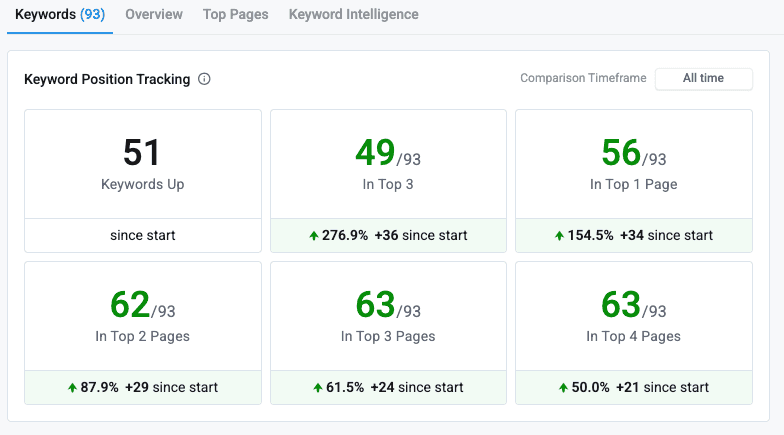
Keyword.com ranking tracking dashboard showing 277% top 3 growth across 93 keywords for dental SEO and AI search optimisation campaign managed by Kaan Turk

The Challenge

A well-established dental practice in Blacktown, Western Sydney had a reputation problem - but not the kind you'd expect. The practice had amassed over 500 five-star Google reviews, making it one of the highest-rated dental clinics in the region. Patients loved the service. The problem was that almost nobody could find the practice online.

Despite the exceptional review profile, the clinic was underperforming in both traditional organic search and the rapidly growing AI search channel. When potential patients searched for dentists in Blacktown - whether through Google, ChatGPT, Perplexity, or Google's AI Overviews - this practice was nowhere to be found. The disconnect between their real-world reputation and their digital visibility was costing them new patient bookings every day.

An initial SEO audit revealed why. The website was built on an outdated, JavaScript-heavy design that created significant barriers for both search engine crawlers and users. Beyond the technical issues, the site had fundamental structural and content problems:

The website lacked dedicated service pages. Instead of individual landing pages targeting specific dental services - each with its own keyword target and entity focus - the site tried to cover everything on a handful of generic pages. This meant the practice was competing for dozens of different search queries with pages that weren't optimised for any of them. The on-page content across the site was thin and generic, failing to demonstrate the expertise or differentiation that would signal quality to Google's algorithms. Industry awards, professional credentials, and trust signals were buried or missing entirely from the site. The header and footer navigation structure was disorganised, making it difficult for both users and crawlers to understand the site's architecture. Schema markup was either outdated or improperly implemented, meaning Google had no structured understanding of the practice's services, location, or credentials.

And then there was the AI search gap. Despite having 500+ five-star reviews - exactly the kind of social proof signal that should influence AI recommendations - the practice was absent from ChatGPT, Perplexity, and Google's AI-generated results when users asked for dentist recommendations in Blacktown. Something was preventing the practice's strong reputation from being picked up by the AI models that increasingly influence how patients find healthcare providers.

The Strategy

This engagement required a dual strategy that addressed both traditional SEO and the emerging AI search landscape. The two channels have overlapping but distinct ranking factors, and optimising for one doesn't automatically optimise for the other.

For the traditional SEO component, I designed a comprehensive local SEO and on-page optimisation plan built around a fundamental principle: one landing page per service entity. Rather than trying to rank generic pages for multiple keywords, I would build a targeted content architecture where each dental service had its own dedicated, fully optimised landing page - creating clear topical relevance signals for Google.

For the AI search component, I needed to investigate why a practice with such strong review signals was invisible to AI platforms. AI models like ChatGPT and Perplexity don't just crawl websites - they synthesise information from multiple structured data sources, review platforms, and citation networks. If a business is missing from the data sources these models rely on, no amount of on-site optimisation will make it visible in AI-generated recommendations.

The 12-month strategy was structured to deliver the technical and on-page foundations first, then layer in content marketing, link building, and AI search optimisation as the site's authority grew.

The Implementation

Technical SEO & Site Redesign

The JavaScript-heavy website design was the first obstacle. I worked through the critical rendering issues to ensure search engines could properly crawl and render every page. This included addressing JavaScript rendering dependencies, improving page load performance, and ensuring that the content Google saw matched what users saw - a common problem with JS-heavy sites where important content may be hidden behind client-side rendering.

The header menu and footer navigation were restructured to create a logical, crawlable site architecture. The new navigation reflected the service-page structure I was building - making it easy for both users and search engines to navigate from the homepage to any specific service page within two clicks.

Schema markup was overhauled across the entire site. I implemented comprehensive LocalBusiness schema, DentalClinic schema, Service schema for each treatment page, and AggregateRating schema to surface the practice's impressive review count in search results. The structured data gave Google a machine-readable map of what the practice offers, where it's located, and how patients rate it.

Keyword Mapping & Service Page Architecture

This was the strategic core of the campaign. I conducted thorough keyword research across the dental services landscape in Western Sydney and built a keyword map that assigned each target keyword group to a specific landing page - enforcing the one-page-per-entity principle.

The primary target was the highly competitive "dentist Blacktown" keyword for the homepage. Beyond that, I created new dedicated service pages for each treatment the practice offers - wisdom teeth removal, dental implants, teeth whitening, root canal therapy, children's dentistry, emergency dental, workers' compensation dental, and more. Each service page was built to own a specific search query and the semantic entities associated with that treatment.

For every new and existing page, I wrote comprehensive SEO content that went beyond generic service descriptions. The content addressed specific patient questions, covered treatment processes, included the clinical terminology Google expects in healthcare content, and wove in the E-E-A-T signals that are particularly critical for health-related queries - where Google applies its highest quality standards under the Your Money or Your Life (YMYL) classification.

Trust Signal & E-E-A-T Implementation

For a healthcare business, E-E-A-T signals aren't optional - they're the primary differentiator in Google's quality assessment. I conducted a strategic placement of trust elements throughout the site. Industry awards and professional recognitions were prominently displayed. Practitioner credentials and qualifications were added to relevant pages. The practice's physical address, contact information, and operating hours were consistently presented across the site - reinforcing the local entity signals that both Google and AI platforms use to verify business legitimacy.

These trust signals served a dual purpose: they directly influenced Google's quality assessment for YMYL content, and they provided the structured, verifiable information that AI models need to confidently recommend a business in their responses.

With the on-page architecture established, I layered in a blog content strategy focused on dental health topics relevant to the Blacktown community. Each blog post served the dual purpose of capturing informational search traffic and creating internal linking pathways back to the commercial service pages - building topical authority across the dental care domain.

The link building component focused on earning authoritative backlinks from relevant healthcare directories, dental industry publications, and local business networks. These external authority signals reinforced the on-site optimisation work and accelerated the ranking improvements for competitive local keywords.

AI Search Optimisation (GEO/AEO)

This is where the engagement broke new ground. When I investigated why a practice with 500+ five-star Google reviews was absent from AI search recommendations, I discovered something critical: ChatGPT was pulling dental practice recommendations from BirdEye, a review and reputation management platform - and the client had no presence on BirdEye at all.

This was the missing link. The practice had invested heavily in building their Google review profile, but AI models don't source exclusively from Google. They aggregate data from multiple platforms, and if a business is missing from a key data source, it's invisible to that AI - regardless of how strong its presence is elsewhere.

I immediately created and claimed a BirdEye profile for the practice. Every field was completed meticulously - business name, address, phone number, images, service categories, and operating hours - ensuring complete NAP consistency with the website and Google Business Profile. The profile was optimised to match the entity signals already established across the website and local citation network.

The result was remarkably fast. Within two weeks of the BirdEye profile going live, the practice began appearing in ChatGPT's recommendations for dental-related queries in Blacktown. Shortly after, visibility expanded to Perplexity and Google's AI-generated results as well.

The Results

The 12-month campaign delivered transformative results across both traditional search and AI platforms.

Keyword Rankings

Keyword ranking tracking dashboard
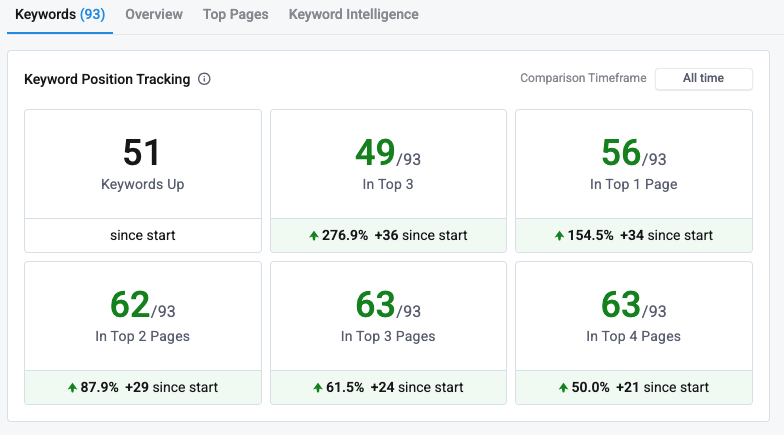
Keyword.com position tracking across 93 monitored keywords showing dominant ranking growth over 12 months.

Metric Before After Change
Keywords in Top 3 13 49 +276.9%
Keywords on Page 1 (Top 10) 22 56 +154.5%
Keywords in Top 20 33 62 +87.9%
Keywords in Top 30 39 63 +61.5%
Keywords in Top 40 42 63 +50.0%
Keywords Moving Up - 51/93 54.8% of tracked terms

The standout metric is the top 3 performance. Having 49 out of 93 keywords in positions 1-3 means the practice now dominates the search results page for the majority of dental queries in their market. Multiple high-value keywords - including terms with 1,000+ monthly search volume - moved from outside the top 15 to position 1.

Keyword detail view
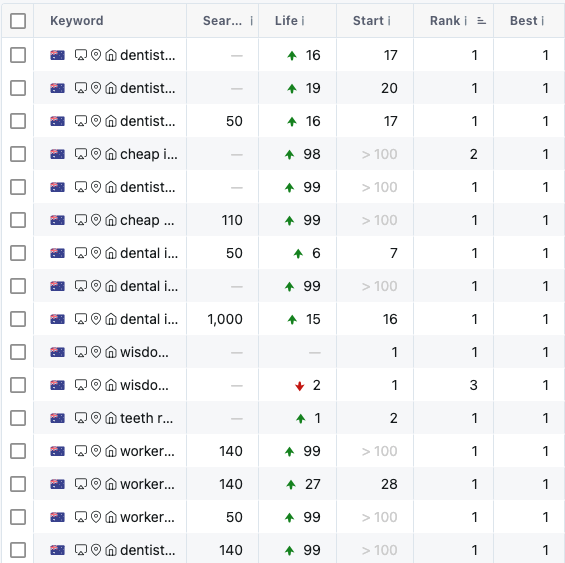
Keyword detail view showing multiple keywords at position 1, with several jumping from beyond position 100 to the top spot.

The keyword detail data reveals the impact of the service page architecture. Keywords for wisdom teeth removal, dental implants, workers' compensation dental, and other specific services all reached position 1 - each on their own dedicated, optimised landing page. This validates the one-page-per-entity strategy: when every service has a focused landing page with targeted content, the ranking potential multiplies across the entire keyword portfolio.

Organic Traffic & Engagement

GA4 traffic acquisition report
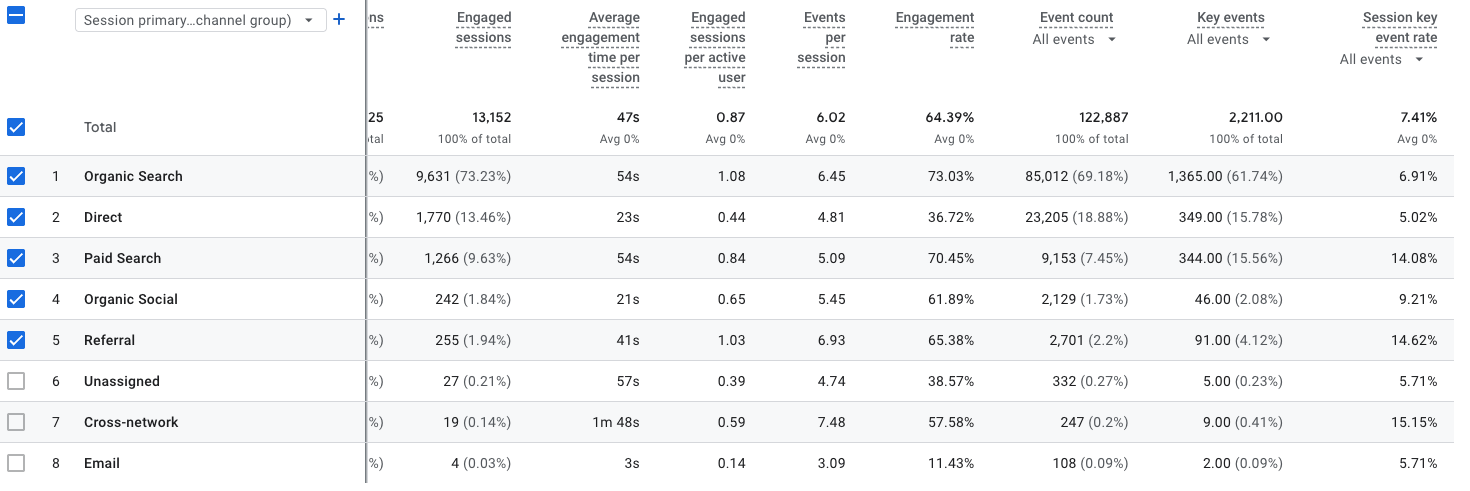
Google Analytics 4 traffic acquisition showing organic search as the dominant channel at 73.23% of total sessions.

Channel Sessions % of Total Engagement Rate
Organic Search 9,631 73.23% 73.03%
Direct 1,770 13.46% 36.72%
Paid Search 1,266 9.63% 70.45%
All Channels 13,152 100% 64.39%

Organic search now drives nearly three-quarters of all website traffic - and with a 73% engagement rate, this isn't passive traffic. Visitors from organic search spend an average of 54 seconds per session, view 1.08 engaged sessions per active user, and trigger 6.45 events per session. These are patients actively exploring services and making appointment decisions.

AI Search Visibility

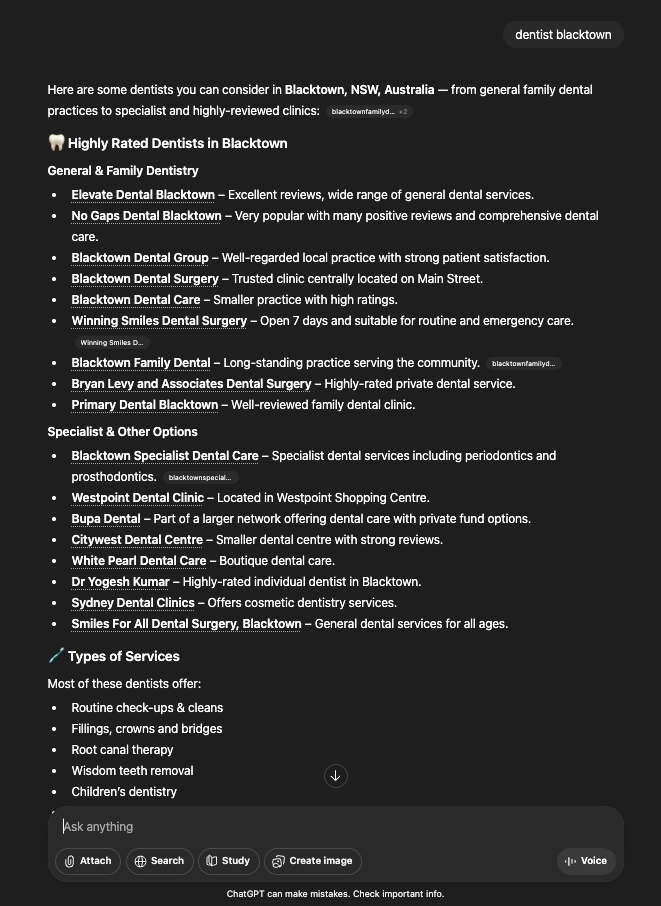
ChatGPT search results for Blacktown dentist
ChatGPT recommending the practice as a top-rated dentist in Blacktown - visibility that didn't exist before the BirdEye optimisation.

GA4 AI referral traffic report
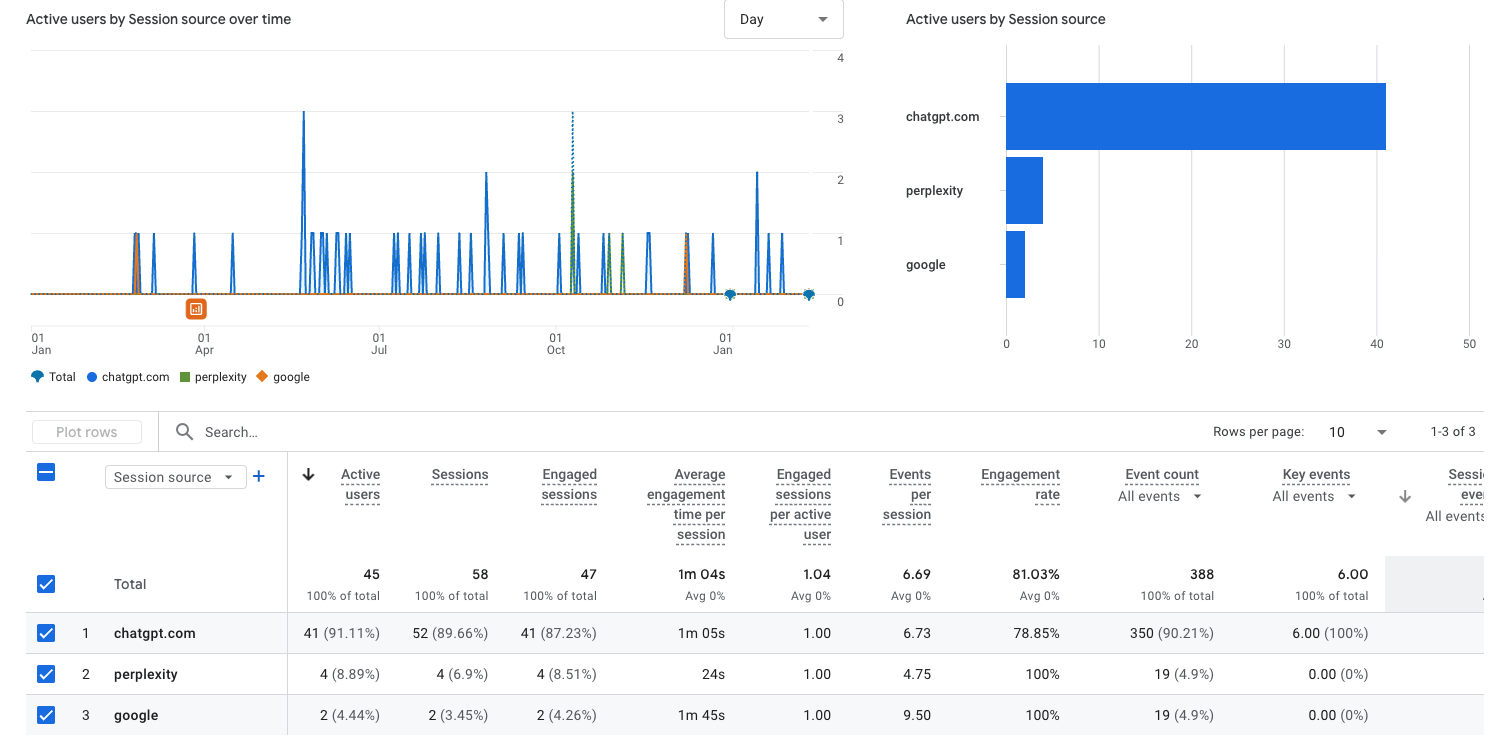
GA4 data showing AI platform referral traffic - ChatGPT drives 91% of AI-sourced visits, with Perplexity and Google AI contributing additional sessions.

AI Platform Active Users Sessions % of AI Traffic
ChatGPT 41 52 89.66%
Perplexity 4 4 6.90%
Google AI 2 2 3.45%
Total AI Referrals 45 58 -

While the absolute numbers from AI platforms are still modest compared to traditional organic search, the significance is in the trajectory and the engagement quality. AI referral visitors show an 81% engagement rate - higher than any other traffic source - and spend over a minute per session. These are high-intent users who've received a direct recommendation from an AI assistant and are visiting to take action.

More importantly, this is a channel that didn't exist at all 12 months ago. AI search is growing exponentially as a discovery channel for local services, and being established in these results now positions the practice to capture an increasing share of patient enquiries as AI adoption continues to accelerate.

Key Takeaways

1. One landing page per service entity is the highest-leverage local SEO architecture.
The practice went from trying to rank generic pages for dozens of keywords to having dedicated, optimised landing pages for each service. The result: 49 keywords in top 3 positions, with multiple service terms reaching position 1. For any local service business - dental, medical, legal, trades - this architectural principle should be the foundation of the SEO strategy.

2. AI search optimisation requires presence across multiple data sources.
Having 500+ five-star Google reviews wasn't enough to appear in ChatGPT's recommendations. AI models aggregate data from platforms beyond Google, and a gap in any key data source creates invisibility. Identifying which platforms specific AI models reference - and ensuring your business is present and optimised on each - is the core of AI search optimisation in 2026.

3. E-E-A-T signals are non-negotiable for healthcare SEO.
Google classifies dental content as YMYL, applying its strictest quality standards. The strategic placement of credentials, awards, and practitioner information throughout the site directly influenced the practice's ability to rank for competitive health-related keywords. For any healthcare provider, E-E-A-T implementation should precede content production.

4. The BirdEye discovery highlights a new SEO discipline.
AI search optimisation - sometimes called GEO (Generative Engine Optimisation) or AEO (Answer Engine Optimisation) - is emerging as a distinct discipline from traditional SEO. The data sources, ranking factors, and optimisation techniques differ from Google. Businesses that establish visibility in AI search results now will have a compounding advantage as these platforms grow.


About This SEO Campaign

Industry: Dental / Healthcare
Location: Blacktown, Western Sydney, New South Wales
Campaign Duration: 12 months (ongoing)
Services Applied: Local SEO, Technical SEO, Content Strategy, Link Building, Schema Markup Implementation, AI Search Optimisation (GEO/AEO)
Primary Goal: Increase organic visibility for dental services and establish presence in AI search platforms
SEO Consultant: Kaan Turk


Running a healthcare practice with great reviews but poor search visibility? Get in touch for a free SEO audit discussion - I'll assess both your traditional search performance and your AI search presence, and show you exactly where the gaps are.

Local SeoOn Page SeoTechnical SeoContent StrategyLink Building
Share:
KT
Kaan TURKAbout
Senior SEO Specialist

15 years of SEO expertise. Former SEO Lead for Louis Vuitton, LC Waikiki, Vakko, Enterprise Rent a Car, and Monster Notebook. Mathematics graduate bringing data-driven precision to search engine optimisation.

Want Similar Results for Your Business?

Every project starts with understanding your unique challenges. Let's discuss how we can transform your organic presence.