The Challenge
A home building and renovations company based in regional Australia came to me with what is arguably the most challenging starting point in SEO: complete invisibility. Across 39 commercially valuable keywords spanning their core services - home building, house extensions, renovations, residential construction, and shed building - every single one sat beyond position 100 in Google. The business didn't just have poor rankings. It had no rankings at all.
This wasn't a case of a site that had declined or been penalised. The website existed, the services were real, and the business had a solid track record of completed building projects. But from Google's perspective, the site simply didn't register as relevant for any of the search queries that their potential customers were using. The site was essentially a digital brochure that nobody could find.
An initial SEO audit revealed the familiar pattern of a website built without SEO consideration from the outset:
The site's on-page content was minimal and generic - the kind of copy that describes what a builder does without targeting any specific search queries or demonstrating depth of expertise. Page titles and meta descriptions were either missing, duplicated, or stuffed with unhelpful branding rather than keyword-targeted messaging. There was no structured data telling Google about the business's services, service areas, or credentials. The internal linking structure was flat and disconnected, with no topical pathways guiding crawlers through the site's content. Off-site authority signals were virtually non-existent - the business had minimal backlinks, inconsistent citations across online directories, and no content marketing presence that would signal relevance and authority to search engines.
For a building company operating in a regional market, organic search is one of the most valuable lead generation channels available. When someone searches for "house extensions" or "home renovations" in their area, they're typically ready to get quotes and start a project. Being invisible for these searches means losing high-intent leads to competitors - many of whom may deliver inferior work but simply have a better online presence.
The Strategy
Building organic visibility from scratch requires a different approach than optimising an existing presence. There are no quick wins to capture - no existing rankings to push from page two to page one, no underperforming pages to refresh. Every ranking has to be earned from the ground up.
I designed a strategy that prioritised building a complete SEO foundation simultaneously rather than sequentially. The rationale was straightforward: with zero existing signals, every element of SEO - technical, on-page, content, authority, and local - needed to be established at the same time to create the critical mass of relevance signals that Google requires before it begins ranking a site for competitive queries.
The competitive landscape in regional building markets has a unique characteristic that informed the strategy. While the keywords have genuine commercial value - a single home building or renovation project can range from $50,000 to $500,000+ - the SEO investment from most competitors is minimal. Regional builders tend to rely on word-of-mouth and paid advertising rather than organic search. This creates a significant opportunity: a builder with a properly optimised website can capture an outsized share of organic search traffic because few competitors are competing seriously for those positions.
The Implementation
Technical SEO Foundation
Before any content or authority-building work could be effective, the site needed a solid technical base. I worked through the full technical SEO checklist: ensuring clean crawlability with an optimised robots.txt and XML sitemap, fixing page speed issues to meet Core Web Vitals thresholds, implementing proper canonical tags to prevent any duplicate content signals, and establishing a clean URL structure that reflected the site's service hierarchy.
Comprehensive schema markup was implemented across the site. LocalBusiness schema established the business entity in Google's understanding. Service schema was added for each service offering - home building, extensions, renovations, residential construction, and shed building - with proper service area definitions. FAQ schema was implemented on key pages to improve rich result eligibility and demonstrate topical depth.
Keyword Mapping & On-Page Optimisation
I conducted detailed keyword research across the building and renovations market in the client's service area, identifying every commercially valuable search query and mapping it to a specific page on the site. The keyword map covered the full spectrum of the business's services: home building, house extensions, home renovations, residential construction, shed building, and related long-tail queries.
For each target page, I executed a complete on-page optimisation program. Meta titles were written to target specific high-intent keywords while maintaining click-through appeal - frontloading the service keyword with a geographic modifier and a differentiating value proposition. Meta descriptions were crafted to drive clicks from the search results page. Heading hierarchies were structured to create clear topical signals from H1 through H3.
The content layer was the most significant investment. Each service page received substantial, SEO-optimised content written from scratch. For a building company, this meant covering the full scope of what potential clients want to know before contacting a builder: the types of projects the business handles, the process from initial consultation through to handover, the materials and methods used, relevant building codes and compliance standards, indicative project timelines, and the credentials and experience that qualify the business to deliver these projects.
The entity coverage was particularly important. Google expects building and construction content to include specific technical and regulatory entities - building permits, Australian building standards, energy efficiency ratings, council approval processes, warranty provisions, and insurance certifications. Pages that cover these entities comprehensively rank better than pages that simply describe services in generic terms, because they demonstrate the topical depth that Google's algorithms associate with genuine expertise.
Authority Building & Off-Page SEO
With zero off-site authority, the link building and citation strategy was essential to complement the on-page work. I developed a multi-channel approach to building the business's digital footprint beyond the website.
Blog content was created to target informational queries in the building and renovations space - the kinds of questions potential clients ask before they're ready to request a quote. Topics like renovation planning guides, extension cost considerations, and building process explanations served as both traffic acquisition content and internal linking sources that passed topical relevance to the commercial service pages.
The business's social media profiles were audited and optimised with consistent NAP (Name, Address, Phone) information, service descriptions, and links back to the website. These profiles were then integrated into the website's footer menu and contact pages, creating a coherent entity presence across platforms. While social media profiles aren't direct ranking factors, they contribute to the overall entity coherence that search engines use to validate a business's legitimacy and service claims.
Local citation building ensured the business was listed consistently across relevant online directories - building industry directories, local business directories, and trade-specific platforms. Each citation reinforced the business's location, service categories, and contact details, strengthening the local authority signals that influence rankings for geographically targeted queries.
Backlink acquisition focused on earning links from relevant, authoritative sources - industry publications, local news outlets, building supplier directories, and community organisations. Each link was evaluated for topical relevance and domain authority rather than pursuing volume for its own sake.
Local SEO & Google Business Profile
The Google Business Profile was fully optimised as part of the local SEO strategy. Service categories were refined to match the keyword-mapped service pages. The business description was rewritten with keyword-targeted, compelling copy. Photos of completed projects were uploaded with optimised descriptions. The service area was configured to accurately reflect the business's geographic coverage.
Regular GBP updates and posts were established to maintain profile freshness - a signal that influences local pack visibility. Review management protocols were implemented to encourage satisfied clients to share their experience, building the social proof layer that influences both rankings and conversions.
The Results

What makes these results remarkable is the starting point. Every single tracked keyword began beyond position 100. The site had zero organic visibility. The campaign didn't improve existing rankings - it created them from nothing.
Key Performance Metrics
| Metric | Before | After | Change |
|---|---|---|---|
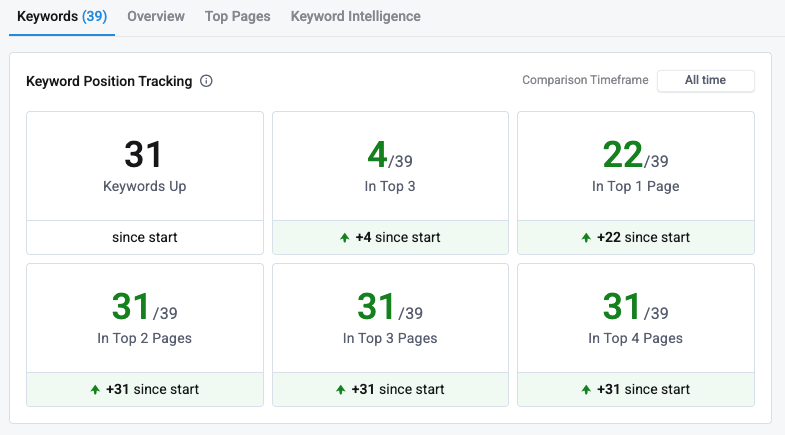
| Keywords in Top 3 | 0 | 4 | From zero |
| Keywords on Page 1 (Top 10) | 0 | 22 | From zero |
| Keywords in Top 20 | 0 | 31 | From zero |
| Keywords in Top 30 | 0 | 31 | From zero |
| Keywords in Top 40 | 0 | 31 | From zero |
| Keywords Moving Up | - | 31/39 | 79.5% of tracked terms |
Ranking Highlights

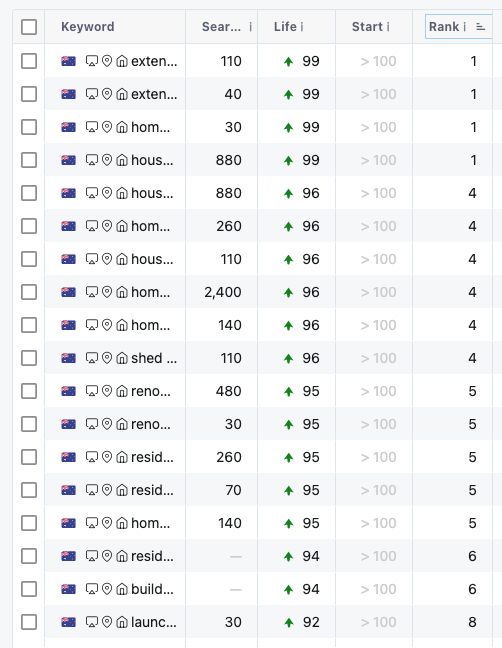
The keyword detail tells a powerful story. A 2,400 monthly search volume home-building keyword - the highest-volume term in the portfolio - moved from beyond position 100 to position 4. Multiple 880 search volume keywords reached position 1 and 4. Extension keywords with 110 search volume climbed from invisible to position 1.
Four keywords now sit in top 3 positions, having each made jumps of 96-99+ positions. These aren't incremental improvements - they're complete transformations from non-existence to dominance. Twenty-two keywords sit on page 1, meaning the business now has a visible presence for the majority of the search queries that drive enquiries in the residential building and renovations market.
The pattern across the portfolio is also telling: 31 out of 39 keywords moved up, and the vast majority of those that improved made jumps of 90+ positions. This indicates that the SEO foundations - the technical setup, the content quality, the authority signals - were strong enough that once Google began recognising the site's relevance, the rankings moved quickly and broadly rather than incrementally for a few isolated terms.
What the Numbers Mean for the Business
For a building company, each of these keyword positions represents direct access to high-value leads. Someone searching for home extensions, renovations, or house building in a specific area is typically in the active research or quoting phase. With 22 keywords on page 1 - and the highest-volume keyword at position 4 - the business is now capturing organic enquiries that it previously had no access to. In an industry where the average project value ranges from tens of thousands to hundreds of thousands of dollars, even a modest number of additional enquiries per month translates to significant revenue growth.
Key Takeaways
1. Zero to page 1 is achievable with comprehensive, simultaneous optimisation.
Starting from no visibility doesn't mean rankings will take years. By building technical, content, authority, and local signals simultaneously rather than sequentially, the site reached critical mass faster - giving Google multiple reinforcing reasons to begin ranking the site for competitive queries.
2. Regional building markets are underserved in organic search.
Most regional builders rely on word-of-mouth and paid advertising, leaving organic search wide open. A properly optimised website in a regional building market can achieve dominant rankings more quickly and at lower cost than in metropolitan markets - with potentially higher ROI given the high value of each building project.
3. Entity-rich content outperforms generic service descriptions.
Building pages that cover permits, compliance standards, construction methods, and project processes - the entities Google expects in building content - dramatically outperform pages that simply list services. This depth of content signals genuine expertise, which is particularly important for high-value service categories where trust is a primary decision factor.
4. Consistent entity signals across platforms accelerate authority building.
Aligning the website, Google Business Profile, social media, and citation profiles with consistent NAP information and service descriptions creates a coherent entity signal that search engines can validate. For a new-to-SEO business, this cross-platform consistency is one of the fastest ways to establish digital legitimacy.
About This SEO Campaign
Industry: Home Building & Renovations
Location: Regional Australia
Campaign Duration: Ongoing
Services Applied: Local SEO, Technical SEO, Content Strategy, Link Building, Schema Markup Implementation, Google Business Profile Optimisation
Primary Goal: Build organic search visibility from scratch for home building, renovations, and extension keywords
SEO Consultant: Kaan Turk
Running a building or trades business with little to no organic search presence? Get in touch for a free SEO audit discussion - even if your site currently has zero rankings, a well-executed SEO strategy can get you onto page one for the keywords that drive real project enquiries.