Case StudyIndustrial Fittings & Stainless Steel Supplies
10 min read

Industrial Fittings eCommerce SEO Case Study: 22 Keywords in Top 3 with 214% Growth

How an Australian industrial stainless steel fittings supplier transformed empty Shopify collection pages into ranking powerhouses, achieving 22 top 3 keyword rankings and 42 page 1 positions across high-intent product categories.

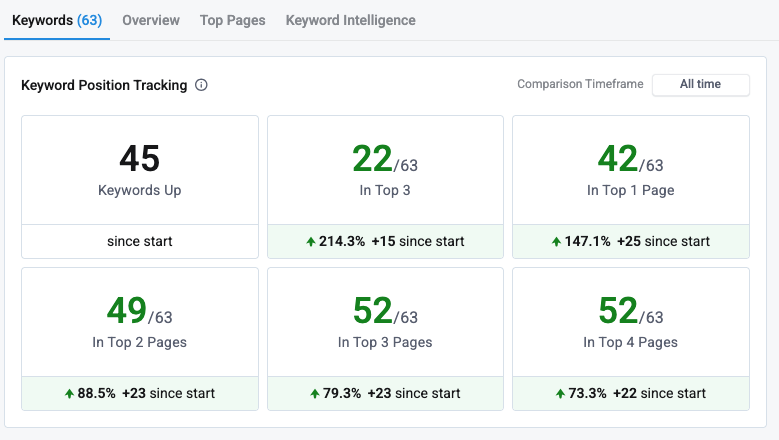
22/63 keywords in top 3 (+214.3%)
Primary Result
42/63 keywords on page 1 (+147.1%)
Secondary Result
Ongoing
Timeframe
Ecommerce SeoOn Page SeoTechnical SeoContent Strategy
Keyword.com ranking tracking dashboard showing 214% top 3 growth across 63 keywords for industrial fittings eCommerce SEO campaign managed by Kaan Turk

The Challenge

An Australian stainless steel fittings supplier operating on Shopify had a product catalogue that should have been generating significant organic traffic. The business stocked a comprehensive range of industrial fittings - tri clamps, flanges, compression fittings, camlocks, buttweld fittings, and ASME-standard components - serving industries from food and beverage processing to pharmaceutical manufacturing, brewing, and industrial fluid handling. The products were there. The demand was there. The search visibility was not.

The core problem was one I encounter frequently with eCommerce Shopify stores that have been set up by product-focused teams rather than SEO-informed developers. The store had created collection pages for every product category - the right structural foundation - but every one of those collection pages was essentially empty from a content perspective. Each page displayed a grid of product images with minimal or no supporting text. No descriptions. No technical specifications. No buying guidance. No content that would give Google any reason to rank these pages above the dozens of competing suppliers selling identical industrial components.

An initial SEO audit confirmed the pattern across the site:

Collection pages were image-heavy with no meaningful text content. Google could see the product images but had no textual signals to understand what the page was about, who it was for, or why it should rank for relevant search queries. Product pages lacked structured data. No product schema, no offer markup, no availability signals - the store was missing every opportunity to appear in rich results for product-related searches. The site architecture was flat, with all products grouped under broad top-level categories and no subcategory structure to capture the specific, high-intent queries that buyers in the industrial fittings market use. Meta titles and descriptions across collection and product pages were generic Shopify defaults or duplicated templates that provided no keyword targeting.

In the industrial fittings market, buyers search with high specificity. They don't search for "fittings" - they search for "tri clamp fittings," "stainless steel compression fittings," "ASME B16.5 flanges," or "camlock couplings." Each of these queries represents a buyer who knows exactly what they need and is ready to purchase. Missing these searches means losing sales to competitors whose pages actually tell Google what they sell.

The Strategy

The strategy was built around a single high-impact principle: transform every collection page from an empty product grid into a content-rich landing page that could compete for specific, high-intent product category keywords.

Industrial fittings is a niche with a unique SEO characteristic. The buyers are technical professionals - engineers, procurement managers, and facility operators - who use precise terminology and search with specific standards and specifications in mind. Content that speaks this language accurately and comprehensively doesn't just rank better; it converts better, because it demonstrates the technical credibility that industrial buyers require before placing orders.

I structured the campaign around three priorities: collection page content creation to establish search relevance, product schema implementation to unlock rich results, and site architecture refinement to capture the full range of product-specific queries across the fittings catalogue.

The Implementation

Collection Page Content Transformation

This was the centrepiece of the campaign. I worked through every target collection page on the site, writing substantial SEO content for each one. But this wasn't generic product category copy - each page received technically accurate, industry-specific content tailored to the exact product category it represented.

For the tri clamp fittings collection, the content covered clamp specifications, gasket compatibility, surface finish grades, pressure ratings, and the food-grade and pharmaceutical applications where tri clamp connections are the industry standard. For flanges, the content addressed ASME and AS standards, pressure classes, material grades, flange face types, and the selection criteria that engineers use when specifying flanges for different service conditions. Compression fittings content covered tube OD compatibility, ferrule types, installation procedures, and the advantages over welded connections in specific applications.

Every piece of content was designed to be placed within the collection page design in a way that complemented rather than disrupted the shopping experience. The content sat alongside the product grid, providing the technical context that helps buyers find the right products while simultaneously giving Google the textual signals it needs to rank the page. This dual-purpose approach - serving both the user and the search engine - is what separates effective eCommerce SEO content from filler text that nobody reads.

Product Schema & Structured Data

Each product page received comprehensive schema markup implementation. Product schema was added with all available structured data properties - product name, description, SKU, price, currency, availability status, brand, material, and condition. Offer schema provided Google with real-time pricing and stock information, improving the store's eligibility for product rich results in search.

At the collection level, I implemented ItemList schema to establish the relationship between category pages and the products they contain. Breadcrumb schema was added to reinforce the site's navigational hierarchy in search results - showing searchers exactly where a product sits within the catalogue structure before they click through.

These structured data enhancements addressed a critical gap. In the industrial fittings market, Google Shopping and product rich results are increasingly prominent in search results pages. Without product schema, the store was invisible in these high-conversion result formats regardless of how well the pages ranked in traditional organic results.

Category & Subcategory Architecture

The original site structure grouped products under broad categories that were too general to rank for specific queries. I restructured the collection hierarchy to create a parent-child architecture with targeted subcategory pages.

For example, rather than a single "stainless steel fittings" collection trying to rank for every related query, the structure was expanded to include dedicated subcategory collections for specific fitting types, sizes, standards, and applications. Each new subcategory page was built with the same level of content optimisation as the parent collections - unique meta tags, targeted content, and proper internal linking back to both the parent category and related subcategories.

This architectural expansion multiplied the site's ranking potential. Every new collection page created a focused entry point from search for queries that the broad parent category couldn't specifically target. The internal linking between parent and child collections also created a topical authority structure that strengthened rankings across the entire product catalogue.

On-Page Optimisation Across the Store

Beyond the collection-level work, I optimised the on-page elements across the entire store. Every collection and product page received a unique, keyword-targeted meta title following a consistent formula: [Product Type] + [Key Specification] + [Brand/Standard] - designed to match the precise search patterns of industrial buyers. Meta descriptions were written to differentiate the store's offering and include compelling calls to action specific to the product category.

Image alt text across the product catalogue was optimised with descriptive, keyword-relevant text - transforming the extensive product photography from an SEO dead zone into an active asset contributing to the site's overall relevance for industrial fittings queries.

The Results

Keyword ranking tracking dashboard
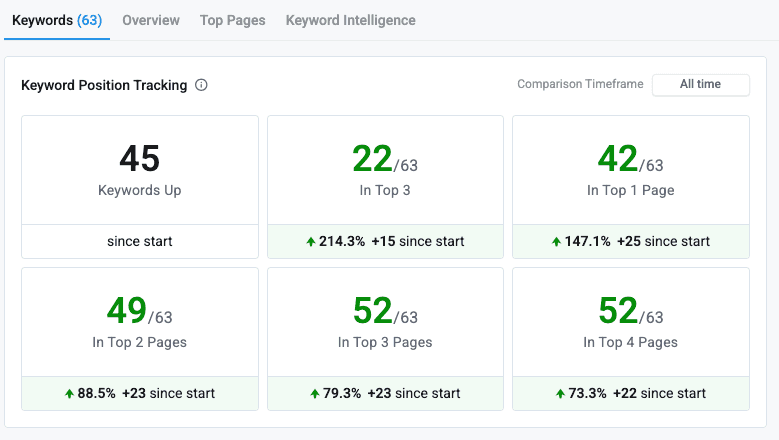
Keyword.com position tracking across 63 monitored keywords showing dominant ranking improvements since campaign start.

The transformation from empty collection pages to ranking powerhouses is reflected clearly in the numbers.

Key Performance Metrics

Metric Before After Change
Keywords in Top 3 7 22 +214.3%
Keywords on Page 1 (Top 10) 17 42 +147.1%
Keywords in Top 20 26 49 +88.5%
Keywords in Top 30 29 52 +79.3%
Keywords in Top 40 30 52 +73.3%
Keywords Moving Up - 45/63 71.4% of tracked terms

Ranking Highlights

Keyword detail view
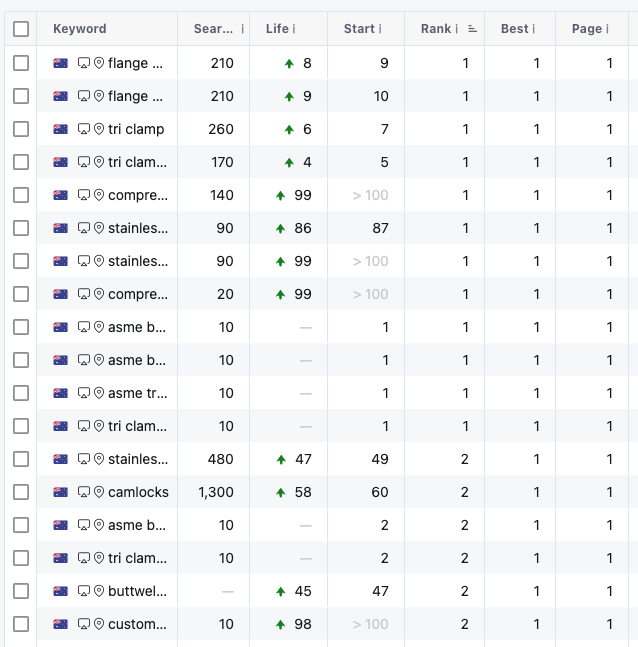
Keyword detail view showing dominant position 1 rankings across multiple industrial fittings categories, with several high-volume keywords jumping from beyond position 100.

The keyword detail data demonstrates the impact of the collection page content strategy. The results span every product category the store sells:

A 1,300 monthly search volume camlock keyword jumped from position 60 to position 2 - a 58-position improvement for one of the highest-volume terms in the industrial fittings space. Multiple stainless steel fitting keywords moved from positions 87-100+ to position 1, representing complete transformations in visibility for these product categories. Tri clamp keywords with 260 search volume climbed from position 7 to position 1, consolidating the store's dominance in the sanitary fittings segment. Compression fitting keywords moved from beyond position 100 to position 1, opening up an entirely new product category in organic search. Flange keywords with 210 monthly searches improved from positions 9-10 to position 1.

The most impressive pattern is the consistency: across flanges, tri clamps, compression fittings, stainless steel components, ASME fittings, camlocks, and buttweld products - every product category improved. This breadth of ranking success validates the systematic approach of optimising every collection page with the same level of thoroughness rather than focusing on a few high-priority categories.

The Content Difference

What makes these results particularly instructive is how directly they trace back to the collection page content work. Before the campaign, these pages were product image grids with no text - and they ranked accordingly. After adding technically accurate, comprehensive content that covers the entities industrial buyers and Google both expect, the same pages now dominate their respective categories. The products didn't change. The design didn't change. The content did - and the rankings followed.

Key Takeaways

1. Empty collection pages are the biggest missed opportunity in eCommerce SEO.
Shopify stores that treat collection pages as simple product grids are leaving rankings on the table. Adding substantial, technically accurate content to collection pages was the single highest-impact change in this campaign. Every collection page that received optimised content improved in rankings - often dramatically.

2. Technical accuracy in content matters for B2B and industrial eCommerce.
Industrial buyers search with precise terminology - ASME standards, specific fitting types, material grades, pressure classes. Content that uses this language accurately doesn't just rank better; it builds the credibility that drives B2B purchase decisions. Generic product descriptions written by someone unfamiliar with the industry will never compete with content that speaks the buyer's language.

3. Product schema is non-negotiable for eCommerce stores.
Without structured data, the store was invisible in product rich results - an increasingly important result format for commercial queries. Implementing comprehensive product schema with price, availability, and specification data unlocked an entirely new layer of search visibility that the on-page optimisation alone couldn't deliver.

4. Niche B2B eCommerce rewards thoroughness over volume.
In consumer eCommerce, you might need thousands of backlinks and years of domain authority to rank for competitive keywords. In industrial niche categories like stainless steel fittings, the competition is thinner - most competitors have poor SEO - and comprehensive on-page optimisation alone can deliver dominant rankings. The investment-to-return ratio in B2B eCommerce SEO is often exceptional.


About This SEO Campaign

Industry: Industrial Fittings & Stainless Steel Supplies
Location: Australia (national eCommerce)
Platform: Shopify
Campaign Duration: Ongoing
Services Applied: eCommerce SEO, Technical SEO, Content Strategy, Schema Markup Implementation
Primary Goal: Rank collection pages for high-intent industrial fittings keywords and drive organic product sales
SEO Consultant: Kaan Turk


Running a B2B or industrial eCommerce store with underperforming collection pages? Get in touch for a free SEO audit discussion - I'll show you exactly which collection pages are missing content, where your schema gaps are, and what it takes to rank for the product keywords your buyers are searching.

Ecommerce SeoOn Page SeoTechnical SeoContent Strategy
Share:
KT
Kaan TURKAbout
Senior SEO Specialist

15 years of SEO expertise. Former SEO Lead for Louis Vuitton, LC Waikiki, Vakko, Enterprise Rent a Car, and Monster Notebook. Mathematics graduate bringing data-driven precision to search engine optimisation.

Want Similar Results for Your Business?

Every project starts with understanding your unique challenges. Let's discuss how we can transform your organic presence.