Case StudyOptometry / Eyewear eCommerce
11 min read

Optometrist eCommerce SEO Case Study: From $1,562 to $26,772 Monthly Organic Revenue

How a Sydney-based optometrist's Shopify store grew from $1,562 to $26,772 in monthly organic revenue through strategic eCommerce SEO, achieving 1,613% revenue growth and $1.58M in annual online sales.

$1,562 → $26,772 monthly organic revenue (+1,613%)
Primary Result
300% increase in page 1 keyword rankings
Secondary Result
12 months (ongoing)
Timeframe
Ecommerce SeoOn Page SeoTechnical SeoContent StrategyLocal Seo
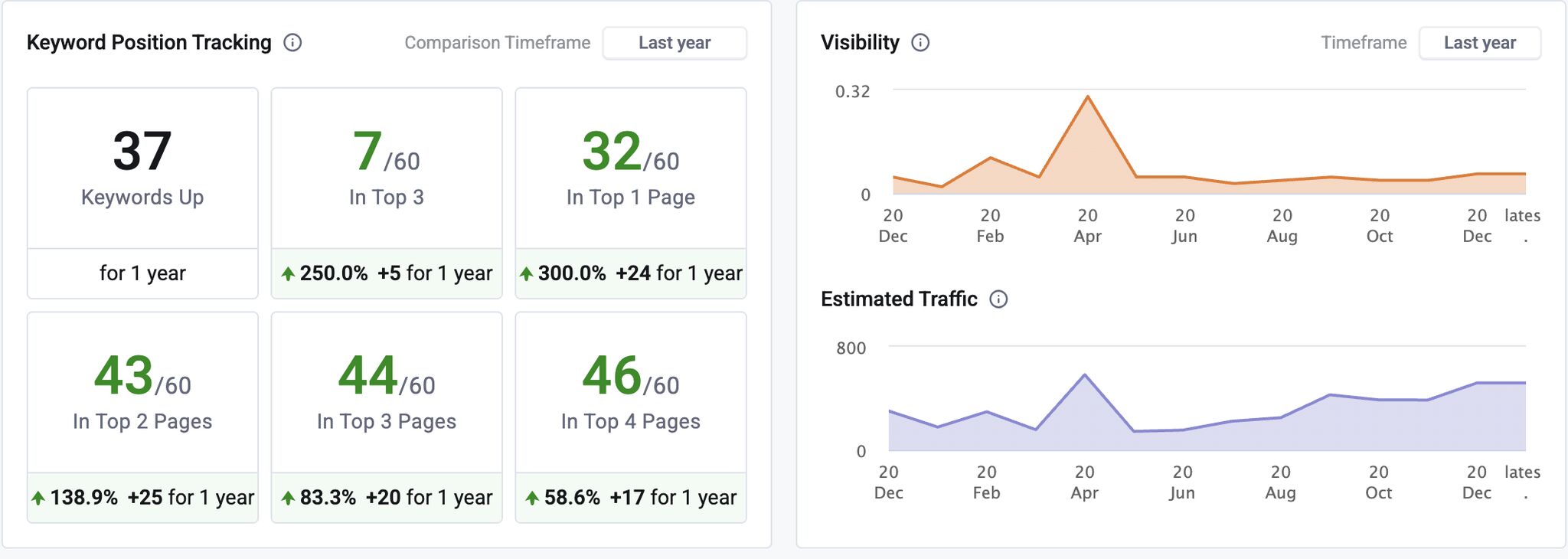
Keyword.com ranking tracking and Shopify revenue dashboard showing 1,613% organic revenue growth for optometrist eCommerce SEO campaign managed by Kaan Turk

The Challenge

An established optometrist practice based in Blacktown, Western Sydney was sitting on an untapped eCommerce opportunity. The business had a strong physical presence inside a busy shopping centre, serving walk-in customers for eye tests, prescription glasses, and contact lenses. They had recently launched a Shopify store to sell eyewear products online - contact lenses, prescription glasses, and sunglasses - but the digital side of the business was barely generating revenue.

When I began the engagement, the numbers told a stark story. The Shopify store's monthly organic revenue from Google sat at just $1,562. For a business with hundreds of SKUs across multiple eyewear categories, that figure represented a fraction of what the product catalogue should have been delivering. Organic traffic was low, search visibility was minimal, and the store was effectively invisible for the commercial keywords that drive eyewear purchases online.

An initial SEO audit identified a pattern I see frequently with Shopify stores that have been set up without SEO guidance from the start. The collection pages and product pages existed - the inventory was there - but none of it had been optimised for search engines. Specifically:

The collection pages had generic or missing meta titles and descriptions, meaning Google had no clear signal about what each page targeted. On-page content across collection pages was either absent or consisted of a few thin sentences that provided no topical depth or keyword relevance. The site suffered from page speed issues that were degrading both user experience and Core Web Vitals scores. No structured data had been implemented - no product schema, no aggregate rating markup, no breadcrumb schema - leaving significant rich result opportunities on the table. The site architecture was flat and shallow, with all products sitting under broad top-level categories and no subcategory structure to capture long-tail and specific search queries.

The business had the product range, the pricing, and the physical credibility of an established optometry practice. What it lacked was an SEO strategy to make the online store visible to the thousands of Australians searching for eyewear products every month.

The Strategy

This was a classic eCommerce SEO engagement where the opportunity was enormous but required a structured, phased approach. Trying to optimise hundreds of product pages simultaneously would have been inefficient. Instead, I designed a 12-month SEO strategy that prioritised commercial impact: start with the collection pages that had the highest revenue potential, build the technical and content foundations to support them, and then systematically expand the site's search footprint.

The strategy was built around four phases. Phase one focused on technical foundations and core collection page optimisation. Phase two expanded the site architecture with new subcategory collection pages. Phase three layered in content marketing through informational blog posts to build topical authority. Phase four - which is still ongoing - focuses on scaling what's working and capturing additional keyword opportunities as the domain's authority compounds.

For an eyewear eCommerce store competing in the Australian market, the SEO landscape presents specific challenges. The category is dominated by large retail chains and marketplace aggregators with significant domain authority. Competing against these players requires a targeted approach: owning the long-tail and mid-tail keywords that the big players overlook, leveraging the trust signals of a physical optometry practice, and building topical depth that generalist competitors can't match.

The Implementation

Technical SEO & Site Speed

Before any content or on-page work could deliver results, the technical foundation needed attention. Site speed was the first priority. Shopify stores are often burdened by heavy theme code, unoptimised images, and excessive third-party app scripts. I worked through the performance bottlenecks systematically - image compression and lazy loading, script deferral, render-blocking CSS elimination, and theme code optimisation - until Core Web Vitals scores moved into the green across all metrics.

Alongside speed improvements, I implemented comprehensive schema markupacross the store. Product schema was added to every product page, including price, availability, and review data. Collection pages received appropriate structured data. Breadcrumb schema was implemented to reinforce the site hierarchy in search results. These structured data enhancements gave Google machine-readable context about the store's product catalogue and immediately improved how the site appeared in search results.

Collection Page Optimisation

This was the highest-impact work in the entire campaign. I began by identifying the priority collection pages - the categories with the strongest commercial intent and search volume in the Australian eyewear market. Think contact lens brands, prescription glasses categories, and sunglasses collections.

For each priority collection page, I executed a complete on-page optimisation overhaul. Meta titles were rewritten to target specific, high-intent keywords while maintaining click-through appeal. Meta descriptions were crafted to differentiate the store from competitors and include clear calls to action. Most critically, I wrote substantial SEO content for every collection page - not the generic filler text that most eCommerce stores use, but genuinely useful, keyword-rich content that addressed searcher intent, covered the semantic entities Google expects in eyewear content, and provided the topical depth needed to compete for commercial keywords.

Site Architecture Expansion

One of the most impactful strategic decisions was expanding the site architecture beyond the original flat category structure. The existing store had broad top-level collections - essentially, all contact lenses in one page, all glasses in another. This structure missed the long-tail opportunity entirely.

I worked with the client to create subcategory collection pages beneath each major category. This expansion served multiple purposes: it created dedicated landing pages for specific search queries that the broad category pages couldn't rank for, it improved internal linking by creating a logical parent-child hierarchy between collections, and it allowed the site to capture far more search queries across the purchase funnel. Each new subcategory page was built with the same level of on-page optimisation as the core collection pages - unique meta tags, keyword-targeted content, proper heading structure, and internal links to related categories and products.

Content Strategy & Topical Authority

With the commercial pages optimised and the architecture expanded, the next layer was building topical authority through informational content. I developed a blog content strategy focused on topics that the store's target audience actively searches for - lens care guides, eyewear buying advice, prescription terminology explanations, and seasonal eye health content.

Each blog post served a dual purpose. First, it captured informational search traffic from users earlier in the purchase funnel - people who might not be ready to buy today but would return when they were. Second, and equally important, each post created internal linking opportunities back to the relevant collection and product pages, passing topical relevance and authority to the commercial pages that drive revenue. This hub-and-spoke approach - with collection pages as hubs and blog content as supporting spokes - is the content architecture model that compounds over time.

Local SEO Integration

As a business with a physical shopfront in a major shopping centre, there was an additional local SEO dimension to leverage. The optometry practice's Google Business Profile was optimised to reinforce both the service side (eye tests, prescriptions) and the retail side (eyewear sales), creating a bridge between the physical location and the online store. This local presence added a layer of trust and entity coherence that pure-play online retailers can't replicate - a genuine competitive advantage in the E-E-A-T framework.

The Results

The results over 12 months have been transformative - not just for the website's search metrics, but for the entire business model.

Revenue Impact

GA4 organic revenue dashboard
Google Analytics 4 organic revenue data comparing the same 28-day period year-over-year.

The headline number speaks for itself. Monthly organic revenue from Google grew from $1,562 to $26,772 - a 1,613% increase comparing the same period year-over-year.

Metric (YoY Comparison) Before After Change
Monthly Organic Revenue $1,562.53 $26,772.49 +1,613.4%
Organic Sessions 12,270 64,978 +429.6%
Organic Transactions 132 1,614 +1,122.7%
Organic Conversion Rate 4.83% 13.01% +169.3%
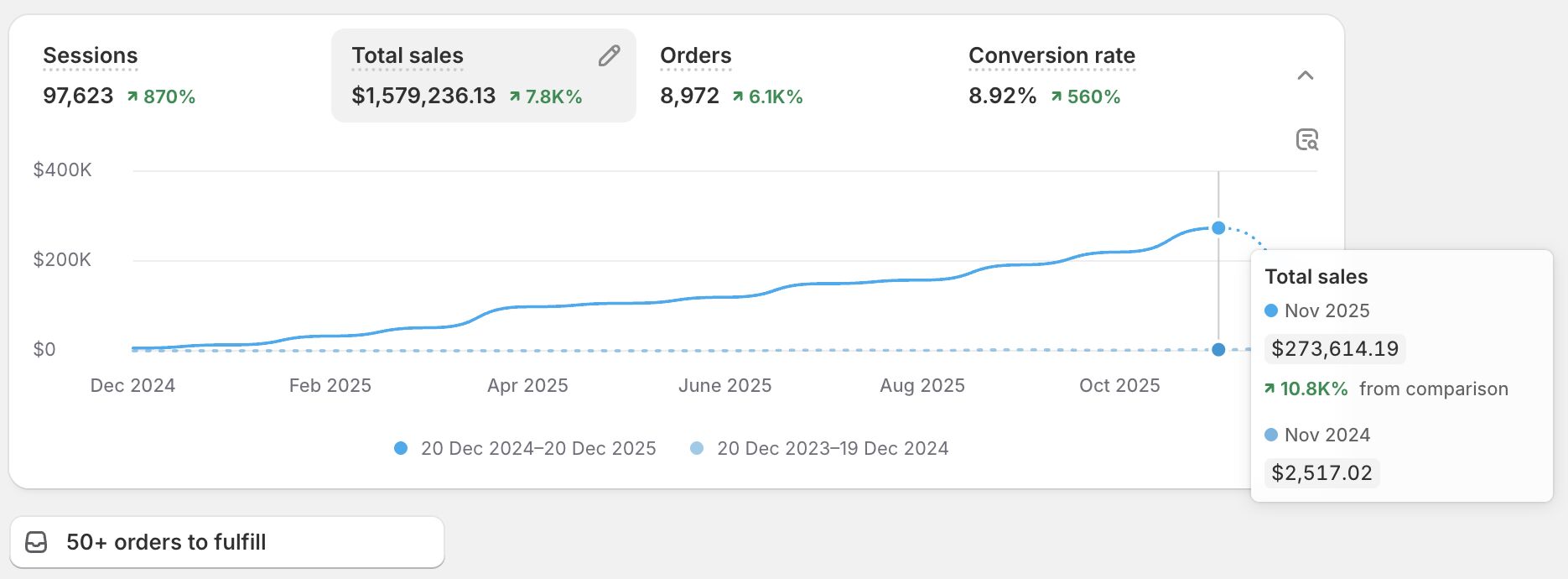
Annual Total Online Sales - $1,579,236 -
Total Annual Orders - 8,972 -
Store Conversion Rate - 8.92% ↑ 560%

What makes these numbers particularly significant is the conversion rate improvement. Organic traffic didn't just increase in volume - it became dramatically more qualified. The conversion rate nearly tripled from 4.83% to 13.01%, meaning the SEO strategy was attracting buyers with genuine purchase intent rather than just browsers.

Keyword Rankings

Keyword ranking tracking dashboard
Keyword.com tracking across 60 monitored keywords showing sustained ranking improvements over 12 months.

Metric Before After Change
Keywords in Top 3 2 7 +250.0%
Keywords on Page 1 (Top 10) 8 32 +300.0%
Keywords in Top 20 18 43 +138.9%
Keywords in Top 30 24 44 +83.3%
Keywords Moving Up - 37/60 61.7% of tracked terms

The page 1 growth - from 8 to 32 keywords - reflects the architectural expansion strategy. Every new subcategory collection page created a new ranking opportunity, and the on-page optimisation ensured those pages entered the index ready to compete.

Organic Traffic Growth

Google Search Console performance report
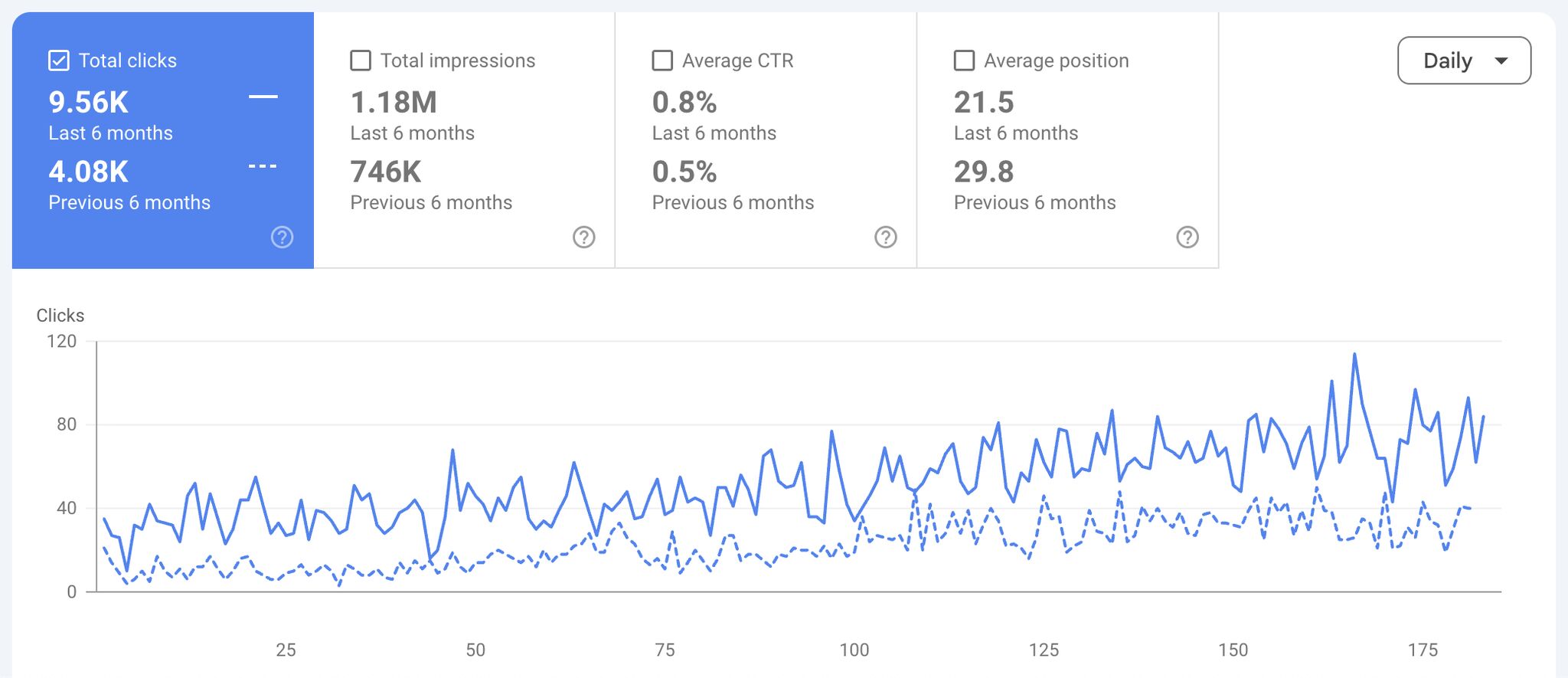
Google Search Console 6-month comparison showing consistent organic traffic acceleration.

Metric (6-Month Comparison) Previous Period Current Period Change
Organic Clicks 4,080 9,560 +134.3%
Impressions 746,000 1,180,000 +58.2%
Average CTR 0.5% 0.8% +60.0%
Average Position 29.8 21.5 ↑ 8.3 positions

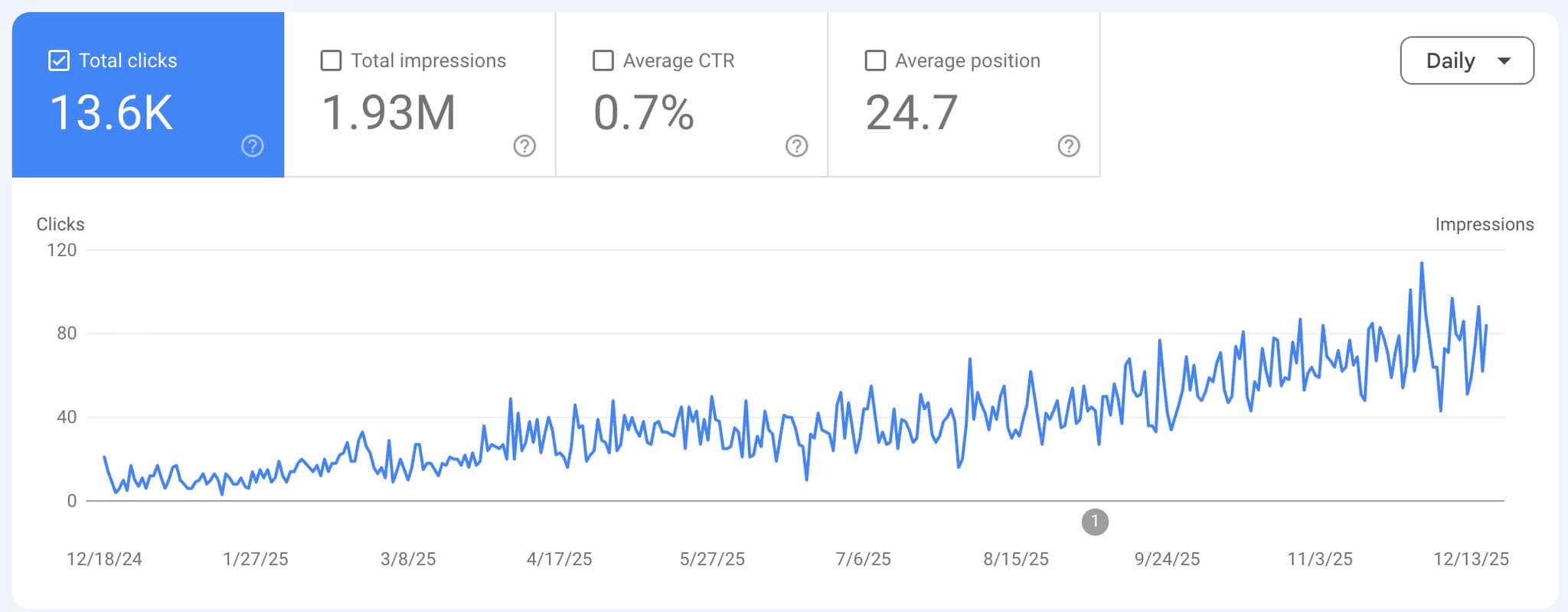
The Search Console data reveals the compounding nature of the strategy. Over the full 12-month period, the site accumulated 13,600 organic clicks from 1.93 million impressions. But the trajectory is what matters most - the daily click chart shows a clear and accelerating upward trend, with the most recent months delivering consistently higher traffic than any previous period. This is the signature pattern of a site building genuine topical authority, not just riding a single keyword spike.

Shopify Store Performance

Shopify analytics dashboard
Shopify analytics showing the total store performance trajectory over the 12-month campaign period.

The Shopify dashboard captures the full picture: $1,579,236 in total annual sales, 8,972 orders, and an 8.92% store-wide conversion rate. The sales trajectory chart shows the classic compounding growth curve - starting near zero and building month over month to a peak of $273,614 in a single month (November 2025), compared to just $2,517 in the same month the previous year.

Key Takeaways

1. Collection page content is the highest-leverage eCommerce SEO investment.
Most Shopify stores treat collection pages as simple product grids. Adding substantial, keyword-targeted content to these pages was the single most impactful change in this campaign. It gave Google the topical signals needed to rank these pages for commercial keywords, and it improved conversion rates by giving shoppers the information they needed to make purchase decisions.

2. Site architecture expansion creates compound keyword opportunities.
Moving from a flat category structure to a parent-child hierarchy with subcategory collection pages multiplied the site's ranking potential. Each new collection page was a new entry point from search - and together, they created an internal linking network that strengthened the entire domain's authority in the eyewear space.

3. Conversion rate improvement can matter more than traffic volume.
The organic conversion rate nearly tripled from 4.83% to 13.01%. This happened because the SEO strategy targeted commercial intent keywords - people searching for specific products they intended to buy - rather than chasing high-volume informational queries. Revenue growth of 1,613% dramatically outpaced the 429% traffic increase because every new visitor was more likely to convert.

4. Physical retail credibility transfers to eCommerce SEO performance.
Having an established optometry practice with a physical location provided E-E-A-T signals that pure online retailers struggle to replicate. Google Business Profile optimisation, consistent NAP data, and the trust signals of a healthcare-adjacent business all contributed to the store's authority in the eyes of both Google and shoppers.


About This SEO Campaign

Industry: Optometry / Eyewear eCommerce
Location: Blacktown, Western Sydney, New South Wales
Platform: Shopify
Campaign Duration: 12 months (ongoing)
Services Applied: eCommerce SEO, On-Page SEO, Technical SEO, Content Strategy, Local SEO, Schema Markup Implementation
Primary Goal: Increase organic revenue from Shopify eCommerce store
SEO Consultant: Kaan Turk


Running an eCommerce store that's not converting organic traffic into sales? Get in touch for a free SEO audit discussion - no pitch deck, no pressure, just an honest assessment of where your store's organic revenue potential stands and what it would take to unlock it.

Ecommerce SeoOn Page SeoTechnical SeoContent StrategyLocal Seo
Share:
KT
Kaan TURKAbout
Senior SEO Specialist

15 years of SEO expertise. Former SEO Lead for Louis Vuitton, LC Waikiki, Vakko, Enterprise Rent a Car, and Monster Notebook. Mathematics graduate bringing data-driven precision to search engine optimisation.

Want Similar Results for Your Business?

Every project starts with understanding your unique challenges. Let's discuss how we can transform your organic presence.