The Challenge
Starting an eCommerce business from scratch is hard enough. Starting one with a website that's effectively invisible to search engines makes it nearly impossible to gain traction without pouring money into paid advertising. That was the situation facing a new Australian socks brand that had launched a Shopify store to sell a curated range of fashion and specialty socks - sheer socks, sneaker socks, yoga socks, coloured socks, invisible socks, mismatched socks, and more.
The store had launched with products listed, collections created, and a functional checkout process. From a commerce perspective, it was ready to sell. From an SEO perspective, it was almost entirely broken.
When I audited the site, the issues were comprehensive but unfortunately typical of Shopify stores built without SEO guidance:
Every collection page was a bare product grid. Not a single collection had any text content - no descriptions, no buying guidance, no keyword-targeted copy. Google could see the product images and prices but had no textual signal to understand what each collection was about or why it should rank for any search query. Meta titles across the store were either Shopify's auto-generated defaults or missing entirely. Meta descriptions were absent, meaning Google was pulling random page fragments as snippets in search results - or not showing the pages at all. Image alt text was missing site-wide. For a product category that's inherently visual, this meant hundreds of product photos were contributing nothing to the store's search relevance. No structured data had been implemented. Without product schema, the store was invisible in Google Shopping's free listings - missing a significant sales channel that requires no advertising spend. The header and footer navigation were disorganised, providing no clear pathway for either shoppers or search engines to navigate the product catalogue logically.
The store had zero organic traffic, zero keyword rankings, and zero revenue from search. Everything needed to be built from the ground up.
The Strategy
Building an eCommerce store's SEO presence from zero requires a focused strategy that prioritises the pages with the highest revenue potential first. I designed a 6-month plan that would establish the foundations quickly, target the collection pages most likely to generate sales, and create a compound growth trajectory where early ranking improvements funded continued optimisation.
The Australian socks market online has an interesting competitive structure. The category is dominated by large fashion retailers and department stores that carry socks as one of thousands of product categories. These generalist retailers have massive domain authority but thin category-level content - a sock collection page on a major department store site typically has even less content than a dedicated sock brand's page. This creates a genuine competitive opening: a specialist store with properly optimised collection pages can outrank generalist retailers for specific sock category keywords, despite having a fraction of the domain authority.
The strategy focused on three priorities: collection page content to establish search relevance for commercial keywords, product schema to unlock Google Merchant free listings, and technical clean-up to remove the barriers preventing Google from properly indexing and understanding the store.
The Implementation
Keyword Mapping & Money Page Identification
I began with keyword research across the Australian socks market, identifying every commercially valuable search query and its monthly search volume. The results revealed clear opportunities: "socks" and "yoga socks" each carried 1,300 monthly searches, "sheer socks" had 590, "coloured socks" and "colourful socks" each had 390, "sneaker socks" had 170, and dozens of long-tail variants targeted specific sock types with genuine purchase intent.
I mapped each keyword group to a specific collection page, creating a clear keyword-to-URL assignment that would guide all subsequent content creation. The money pages - the collection pages targeting the highest-volume, highest-intent keywords - were prioritised for immediate optimisation. These were the pages that would generate revenue fastest once they started ranking, creating a positive feedback loop where organic sales justified continued SEO investment.
Collection Page Content Creation
This was the core of the campaign. I wrote SEO-optimised content for every priority collection page, transforming each from an empty product grid into a content-rich landing page.
Each collection received unique content tailored to its specific product category and target audience. The sheer socks collection content covered denier weights, fabric compositions, styling occasions (office wear, formal events, everyday elegance), care instructions, and the sizing considerations specific to sheer hosiery. The yoga socks collection addressed grip features, material breathability, toe styles (full toe vs. toeless), and the functional requirements that differentiate yoga socks from standard athletic socks. The sneaker socks collection covered the no-show design elements, cushioning levels, moisture management, and the fit considerations that prevent them slipping inside shoes.
The content was implemented in a way that complemented the existing store design rather than disrupting it. Each collection page maintained its product grid layout with the new content positioned to provide context and buying guidance before shoppers browse the product options. This approach is critical for eCommerce - content that pushes products below the fold or interrupts the shopping experience hurts conversion rates regardless of how well it performs in search.
Technical SEO & Missing Element Resolution
I worked through the full technical clean-up systematically. Every page on the store received a unique, keyword-targeted meta title following a consistent format that balanced search optimisation with click-through appeal. Meta descriptions were written for every indexable page, providing compelling summaries that differentiate the store from competitors in search results.
Image alt text was added across the entire product catalogue. For a socks brand where the visual presentation is a key purchase driver, descriptive alt text served a dual purpose: it improved the store's relevance for image search queries (a significant traffic source for fashion products) and it provided accessibility improvements for visually impaired shoppers using screen readers.
The header menu was restructured to create a logical navigation hierarchy that reflected the keyword-mapped collection structure. The footer menu was updated with complete navigation links, trust signals, and the structural elements that help search engines understand the site's content organisation.
Schema Markup & Google Merchant Integration
Product schema implementation was a particularly high-impact element of this campaign. I added comprehensive structured data to every product page - product name, description, price, currency, availability, brand, colour, material, and condition. This structured data served a critical function beyond standard organic search: it enabled the store's products to appear in Google Merchant Center's free product listings.
Google's free listings allow products with proper schema markup to appear in the Shopping tab of search results without any advertising spend. For a new store with no paid advertising budget, this represented a free sales channel that could generate transactions from day one of the schema implementation. The structured data ensured every product met Google Merchant's data requirements, and the products began appearing in free listings shortly after implementation.
This is a strategy I recommend for every eCommerce store, but it's particularly impactful for new stores with limited budgets. Paid Shopping ads can cost significant money in competitive categories. Free listings provide the same product visibility - in the same Shopping tab - without any cost per click.
The Results
Within six months of starting from zero, the store established a genuine organic revenue stream and a ranking foundation that continues to compound.
Keyword Rankings

| Metric | Before | After | Change |
|---|---|---|---|
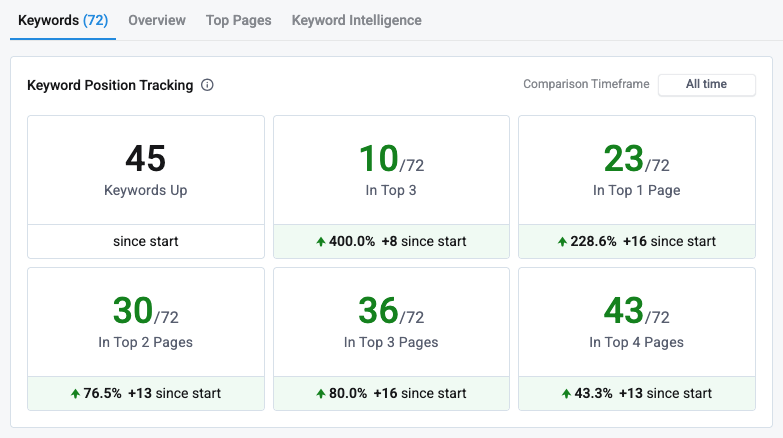
| Keywords in Top 3 | 2 | 10 | +400.0% |
| Keywords on Page 1 (Top 10) | 7 | 23 | +228.6% |
| Keywords in Top 20 | 17 | 30 | +76.5% |
| Keywords in Top 30 | 20 | 36 | +80.0% |
| Keywords in Top 40 | 30 | 43 | +43.3% |
| Keywords Moving Up | - | 45/72 | 62.5% of tracked terms |
Ranking Highlights

The collection page content strategy produced clear, attributable results across multiple product categories:
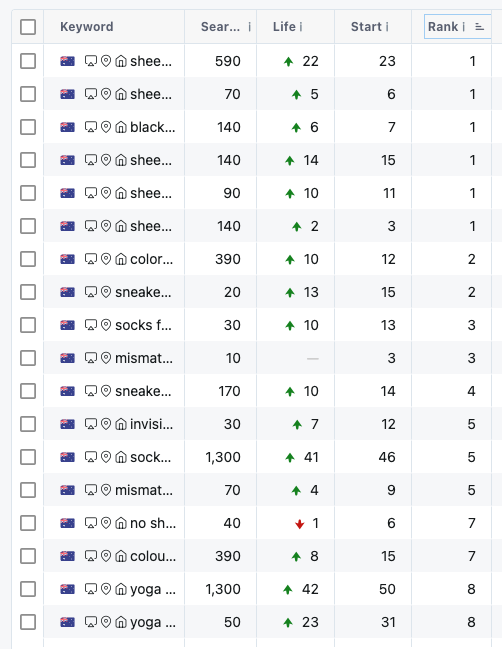
"sheer socks" (590 SV) - position 23 → position 1. The highest-volume category keyword owned by the store now sits at the top organic position.
"sheer socks" variant (70 SV) - position 6 → position 1.
"black socks" (140 SV) - position 7 → position 1. A competitive generic keyword now at the top spot.
"coloured socks" (390 SV) - position 12 → position 2, with the variant "colourful socks" (390 SV) moving from position 15 to position 7.
"sneaker socks" (170 SV) - position 14 → position 4, with a variant at position 2.
"socks" (1,300 SV) - position 46 → position 5. The most competitive single-word keyword in the category made a 41-position jump and continues to climb.
"yoga socks" (1,300 SV) - position 50 → position 8. Another high-volume keyword made a 42-position improvement to reach page 1.
Organic Traffic Growth

| Metric | Value |
|---|---|
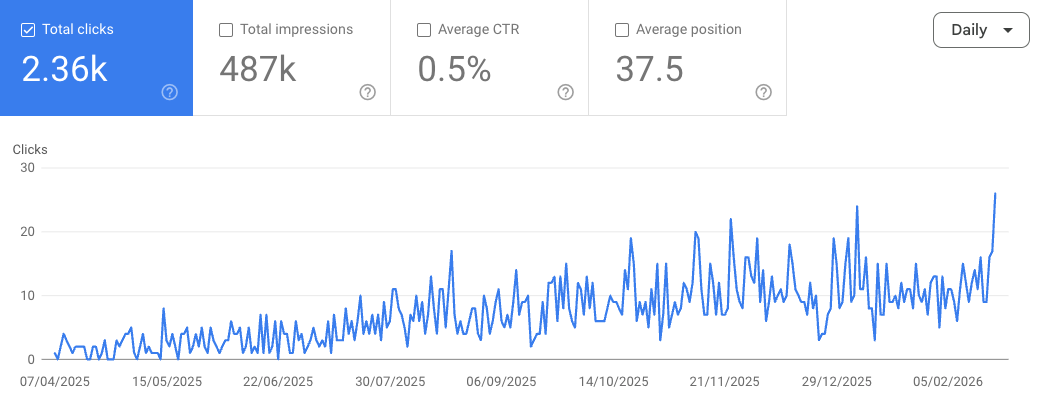
| Total Organic Clicks | 2,360 |
| Total Impressions | 487,000 |
| Average CTR | 0.5% |
| Average Position | 37.5 |
The Search Console chart tells the growth story clearly. The site went from near-zero daily clicks to a consistent baseline of 10-15 clicks per day, with the most recent weeks showing a sharp acceleration to 20-25+ daily clicks. This hockey-stick trajectory in the final months reflects the compound effect of multiple collection pages reaching page 1 simultaneously - each new page 1 ranking adds incremental traffic that contributes to an accelerating growth curve.
The average position of 37.5 across 72 tracked keywords indicates significant remaining upside. As the keywords currently on page 2-3 continue to improve - many of which are on a clear upward trajectory - the traffic growth will accelerate further.
Revenue Impact
The bottom line: a store that launched with zero organic revenue reached $2,000 in monthly organic sales within 6 months. For a new eCommerce business, this represents a self-sustaining revenue stream that grows without proportional increases in spending - unlike paid advertising, where stopping the spend stops the traffic. The organic revenue provides a foundation that the business can reinvest into inventory, product development, and further SEO optimisation to capture additional keyword opportunities.
Key Takeaways
1. New Shopify stores can rank within months - if the SEO foundations are built correctly from the start.
This store went from zero to 23 page 1 keywords in 6 months. The speed is achievable because most competitors in niche eCommerce categories have weak SEO - generalist retailers have thin category content, and competing specialist stores often have the same empty-collection-page problem. Properly optimised collection pages can rank faster than most store owners expect.
2. Google Merchant free listings are a zero-cost revenue channel that every eCommerce store should activate.
Implementing product schema enabled the store's products to appear in Google Shopping's free listings from day one. For a new store with no advertising budget, this provided immediate product visibility in one of Google's most commercially valuable result formats - without spending a cent on ads.
3. Collection page content is the single highest-leverage investment for a new eCommerce store.
Before the content was added, collection pages were invisible to Google. After adding targeted, well-written content to each collection, those same pages began ranking for their target keywords within weeks. The content investment was modest relative to the revenue it generated - making it the most efficient use of an early-stage eCommerce marketing budget.
4. A specialist niche store can outrank major retailers with content depth alone.
Department stores and large fashion retailers carry socks as one of thousands of categories. They'll never write 500 words of expert content about sheer sock denier weights or yoga sock grip patterns. A specialist brand that does invest in this content depth creates a relevance advantage that domain authority alone can't overcome - levelling the playing field for smaller stores with genuine product expertise.
About This SEO Campaign
Industry: Fashion / Socks eCommerce
Location: Australia (national eCommerce)
Platform: Shopify
Campaign Duration: 6 months (ongoing)
Services Applied: eCommerce SEO, Technical SEO, Content Strategy, Schema Markup Implementation, Google Merchant Optimisation
Primary Goal: Build organic search visibility and revenue from scratch for a new Shopify eCommerce store
SEO Consultant: Kaan Turk
Launching a new eCommerce store and want to build organic traffic from day one? Get in touch for a free SEO audit discussion - I'll identify the fastest path to page 1 for your product categories and help you start generating organic revenue without depending entirely on paid ads.