Case StudySolar Energy & Electrical Services
11 min read

Solar Energy SEO Case Study: 4,400 Search Volume Keyword from Invisible to Position 1

How a Tasmania-based solar energy business went from invisible for its highest-value keyword to position 1, achieving 467% top 3 keyword growth and dominant local visibility across solar, off-grid, and HVAC services.

Position >100 → #1 for 4,400 SV keyword
Primary Result
466.7% increase in top 3 keyword rankings
Secondary Result
Ongoing
Timeframe
Local SeoOn Page SeoTechnical SeoContent Strategy
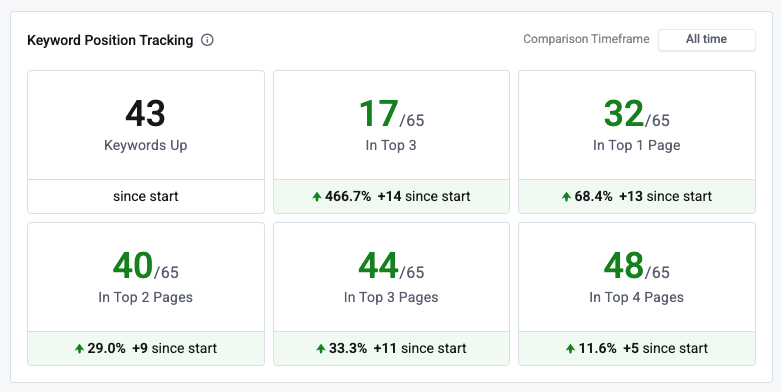
Keyword.com ranking tracking dashboard showing 467% top 3 growth and 43 keywords improving for Tasmanian solar energy SEO campaign managed by Kaan Turk

The Challenge

A solar energy and electrical services company operating across Tasmania wanted to grow their business through organic search but had minimal visibility for the keywords that mattered most. The business offered a range of services - residential and commercial solar panel installations, off-grid solar systems, ducted air conditioning, and cooling solutions - serving customers across the state. They had the technical expertise, the installation track record, and the local knowledge to compete with any provider in Tasmania. What they didn't have was an online presence that reflected any of it.

When I began the engagement, the site's search performance painted a clear picture of missed opportunity. The business's highest-value keyword - a solar-related term with 4,400 monthly searches - was ranked beyond position 100. For all practical purposes, the business was invisible for the single search query that drives the most commercial intent in their industry. Other critical service keywords across solar installation, off-grid systems, and HVAC services were similarly underperforming, with most sitting well outside page one.

An initial SEO audit identified the core issues holding the site back:

The site lacked a coherent keyword strategy. Pages existed for the various services, but there was no deliberate mapping between target keywords and specific landing pages. Multiple pages competed for similar terms with none optimised well enough to rank. The on-page content across service pages was thin and lacked the entity coverage that Google expects for solar energy and electrical services content - technical specifications, system types, energy output metrics, compliance standards, and location-specific information. The Google Business Profile was underoptimised, missing service descriptions, category refinements, and the location-specific signals that drive local pack visibility in Tasmania's regional market. The site had no case studies, credentials display, or FAQ sections - missing the trust and authority signals that influence both rankings and conversions. Technical SEO issues including schema markup gaps, meta tag problems, and structural inefficiencies were limiting the site's crawlability and search engine understanding.

The opportunity was significant. Tasmania's solar market is growing rapidly, driven by energy cost concerns and government incentive programs. The businesses that dominate organic search for solar installation queries in this market will capture a disproportionate share of that growth - and at the time, most local competitors had invested minimally in SEO.

The Strategy

I designed a comprehensive local SEO strategy built around two principles: first, establish clear topical authority across the business's full service range through targeted content and entity optimisation; and second, build the trust and authority signals that differentiate a credible solar provider from the dozens of competitors that appear and disappear in this market.

The Tasmanian solar market has a characteristic that made the strategy particularly effective: it's a defined geographic region with a manageable competitive landscape. Unlike mainland capital cities where solar installers compete in markets with dozens of well-funded competitors, Tasmania's relative isolation means that a properly optimised site can establish dominance faster - provided the SEO work covers every layer thoroughly.

Rather than focusing narrowly on solar panel keywords, I built the strategy to capture the full scope of the business's service offering - solar installations, off-grid systems, ducted heating and cooling, and general electrical work. This breadth would create a compound effect: each service cluster would strengthen the domain's overall topical authority, and the internal linking between related services would reinforce relevance signals across the entire site.

The Implementation

Keyword Mapping & Page Architecture

The foundation of the campaign was a comprehensive keyword mapping exercise. I mapped every commercially valuable keyword in the Tasmanian solar, off-grid, and HVAC market to a specific landing page, ensuring no keyword cannibalisation and no gaps in coverage.

Each target page was assigned a primary keyword, secondary keywords, and a set of semantic entities to cover. This mapping document became the blueprint for all subsequent content creation - ensuring that every page had a clear purpose in the overall search strategy and that no two pages competed for the same query.

Where the existing site had service pages that tried to cover too much, I restructured them into focused landing pages - each targeting a specific keyword cluster. Where keyword research revealed high-value queries with no existing page, I identified the gaps and planned new pages to capture those opportunities.

On-Page Optimisation & Entity-Driven Content

With the keyword map in place, I worked through every target page on the site. Each page received a complete on-page overhaul: optimised meta titles and descriptions, restructured heading hierarchies, and - most importantly - substantial new content written from scratch.

The content approach went beyond simple keyword targeting. For each page, I identified the entity gaps - the specific topics, technical details, and contextual information that Google expects to find on an authoritative page about that subject. For solar installation pages, this meant covering system sizing, panel types, inverter technology, battery storage options, Tasmanian climate considerations, government rebate programs, and the Clean Energy Council accreditation that legitimate installers must hold. For off-grid pages, it meant detailed coverage of standalone system design, battery capacity planning, backup generator integration, and the specific regulatory requirements for off-grid installations in Tasmania.

This entity-driven content approach is what separates pages that rank from pages that merely exist. Google's algorithms evaluate not just whether a page mentions a keyword but whether it demonstrates comprehensive understanding of the topic - and the entities surrounding that topic - at a level consistent with genuine expertise.

USP Integration & Trust Signals

A critical but often overlooked component of SEO for local service businesses is communicating clear unique selling propositions through both the content and the design. I worked with the client to identify their genuine differentiators - years of Tasmanian experience, specific certifications, completed installation portfolio, and service guarantees - and integrated these throughout the site.

A dedicated case studies page was created to showcase completed projects with real results. Professional credentials and industry accreditations were given prominent placement on key pages. An FAQ section was built for each major service, addressing the specific questions Tasmanian customers ask about solar installations, off-grid systems, and HVAC solutions. These elements served a triple purpose: they improved on-page engagement signals, they provided E-E-A-T evidence for Google's quality assessment, and they addressed conversion barriers that prevent visitors from making enquiry decisions.

Technical SEO & Schema Implementation

The technical layer addressed the structural issues identified in the audit. Comprehensive schema markup was implemented across the site - LocalBusiness schema, Service schema for each offering, FAQ schema for the question-and-answer sections, and Review schema to surface customer ratings in search results.

Meta tags were optimised site-wide, with unique, keyword-targeted titles and descriptions for every indexable page. Internal linking was restructured to create clear topical pathways between related services - solar installations linking to battery storage, off-grid systems linking to backup generators, and all service pages linking to the credentials and case studies that reinforce authority.

Google Business Profile Optimisation

For a regional service business, the Google Business Profile is often the first touchpoint with potential customers. I fully optimised the profile with service-specific descriptions, proper primary and secondary category selection, and location-relevant content. Service area definitions were configured to accurately reflect the business's Tasmanian coverage area. Regular post updates and review management protocols were established to maintain profile freshness and engagement signals.

The Results

Keyword ranking tracking dashboard
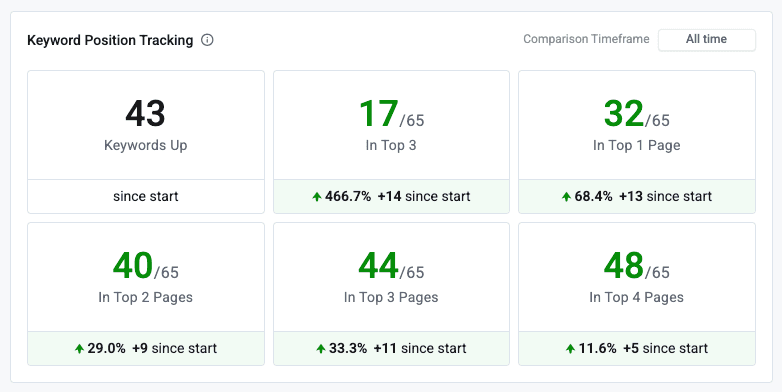
Keyword.com position tracking across 65 monitored keywords showing comprehensive ranking growth since campaign start.

The results demonstrate what happens when every layer of SEO is executed thoroughly in a regional market with genuine competitive opportunity.

Key Performance Metrics

Metric Before After Change
Primary Keyword Position (4,400 SV) >100 1 ↑ 99+ positions
Keywords in Top 3 3 17 +466.7%
Keywords on Page 1 (Top 10) 19 32 +68.4%
Keywords in Top 20 31 40 +29.0%
Keywords in Top 30 33 44 +33.3%
Keywords in Top 40 43 48 +11.6%
Keywords Moving Up - 43/65 66.2% of tracked terms

Ranking Highlights

The campaign's defining result is the primary keyword - a solar-related term with 4,400 monthly searches that moved from completely invisible (beyond position 100) to position 1. This single keyword alone represents a transformative shift in the business's visibility. In the solar industry, where a single residential installation can be worth $8,000-$15,000 and a commercial project significantly more, owning the top position for the highest-volume search term in the state translates directly to revenue.

Keyword detail view
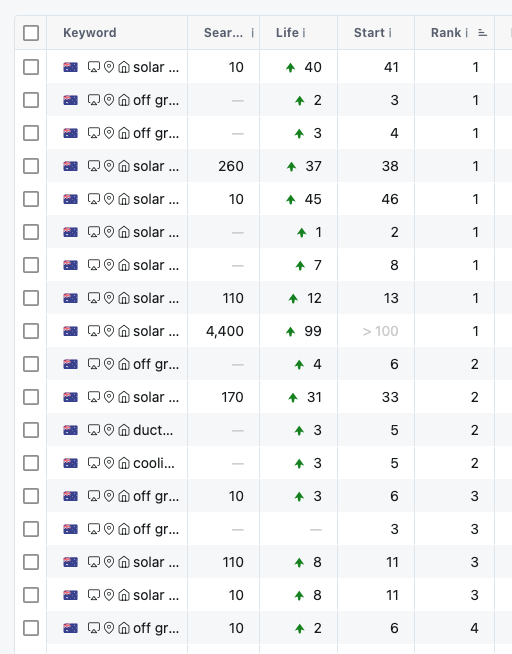
Keyword detail view showing position 1 rankings across multiple service categories including solar, off-grid, ducting, and cooling.

Beyond the headline keyword, the breadth of the ranking improvements validates the multi-service strategy. The business now holds position 1 or 2 for keywords across every service vertical - solar installations, off-grid systems, ducted air conditioning, and cooling solutions. Several keywords made dramatic jumps: a 260 search volume solar term moved from position 38 to 1, another moved from position 46 to 1, and multiple off-grid keywords that started at positions 3-6 climbed to position 1.

The top 3 growth - from 3 to 17 keywords - is particularly significant because top 3 positions capture the majority of clicks for local service queries. With 17 keywords in these positions, the business is now the dominant search result across its entire service portfolio in the Tasmanian market.

Multi-Service Visibility

What makes this campaign notable is the cross-vertical ranking success. The keyword data shows that the business isn't just ranking for solar - it's ranking for off-grid systems, ducted heating, and cooling solutions simultaneously. This validates the strategy of building topical authority across the full service range rather than focusing narrowly on a single keyword cluster. Each service vertical reinforces the others, creating a domain-level authority signal that benefits every page on the site.

Key Takeaways

1. A 4,400 search volume keyword can move from invisible to #1 with comprehensive on-page optimisation.
This keyword didn't require a massive link building campaign or years of domain authority building to reach position 1. It required the right page, targeting the right keyword, with content that demonstrated genuine topical expertise through comprehensive entity coverage. When the content quality and relevance alignment are right, even high-volume keywords can move dramatically.

2. Entity gap analysis is more valuable than traditional keyword density.
Rather than focusing on keyword frequency, I identified what information was missing from each page - the entities, technical details, and contextual coverage that Google expects from an authoritative source on that topic. Filling these entity gaps is what transforms a thin page into a page that genuinely deserves to rank.

3. Multi-service businesses should optimise broadly, not narrowly.
The temptation for a solar company is to focus all SEO investment on solar keywords. By also optimising for off-grid, ducting, and cooling keywords, the campaign created a compound authority effect - each service cluster strengthened the domain's overall relevance, and the cross-linking between services created a content ecosystem that benefits every page.

4. Regional markets reward thorough SEO with outsized returns.
Tasmania's defined geography and manageable competitive landscape meant that comprehensive SEO work produced dominant rankings faster than it would in a mainland capital city. For businesses operating in regional Australian markets, the ROI on SEO is often significantly higher than in metro areas - the investment required is lower but the relative impact is greater.


About This SEO Campaign

Industry: Solar Energy & Electrical Services
Location: Tasmania, Australia
Campaign Duration: Ongoing
Services Applied: Local SEO, Technical SEO, Content Strategy, Link Building, Schema Markup Implementation, Google Business Profile Optimisation
Primary Goal: Establish organic dominance across solar, off-grid, and HVAC keywords in the Tasmanian market
SEO Consultant: Kaan Turk


Running a solar or electrical services business and struggling to rank for your most valuable keywords? Get in touch for a free SEO audit discussion - I'll show you exactly where your entity gaps are and what it takes to own page one in your market.

Local SeoOn Page SeoTechnical SeoContent Strategy
Share:
KT
Kaan TURKAbout
Senior SEO Specialist

15 years of SEO expertise. Former SEO Lead for Louis Vuitton, LC Waikiki, Vakko, Enterprise Rent a Car, and Monster Notebook. Mathematics graduate bringing data-driven precision to search engine optimisation.

Want Similar Results for Your Business?

Every project starts with understanding your unique challenges. Let's discuss how we can transform your organic presence.