The Outcome
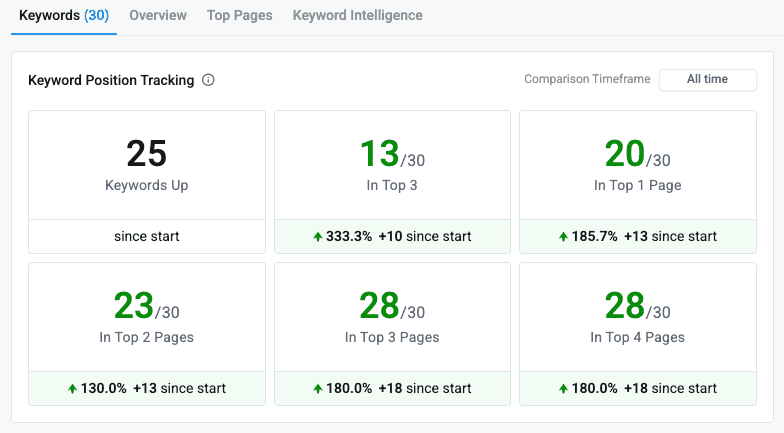
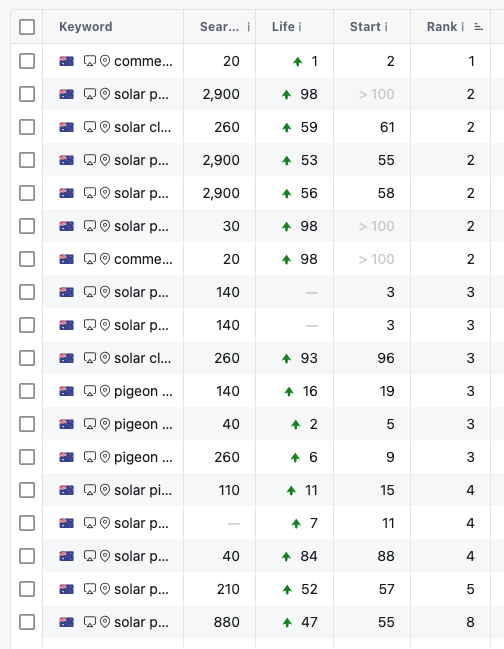
The primary service keyword, a 2,900 monthly search volume term and the highest commercial-intent query in the solar panel cleaning space, moved from position 55 to position 1. That single shift changed who the business was visible to: buyers actively searching for the service. Across 30 tracked keywords, 25 moved up, that is 83% of every monitored term improving.
| Metric | Before | After | Change |
|---|---|---|---|
| Primary Keyword Position (2,900 SV) | 55 | 1 | ↑ 54 positions |
| Keywords in Top 3 | 3 | 13 | +333.3% |
| Keywords on Page 1 (Top 10) | 7 | 20 | +185.7% |
| Keywords in Top 20 | 10 | 23 | +130.0% |
| Keywords in Top 30 | 10 | 28 | +180.0% |
| Keywords Moving Up | - | 25/30 | 83% of tracked terms |
Beyond the headline keyword, the gains were broad. Multiple high-volume solar panel service keywords moved from beyond position 100, essentially invisible, to page one. Pigeon proofing keywords, a secondary but valuable service line, climbed from positions 5-19 to consistent top 3 rankings. Even the lower-volume commercial cleaning terms reached position 1, capturing a niche segment with strong conversion intent.
What matters most is the trajectory. The tracking shows consistent upward movement across all keyword categories, not a single spike. That is the signature of foundational work compounding into durable authority rather than fragile, short-lived gains.
Business impact
The dashboard tells one story. The booking calendar tells a better one. The business went from an empty calendar to fully booked for the next two months. The quality of inbound leads shifted too: enquiries now come from people actively searching for solar panel cleaning in Brisbane rather than low-intent or out-of-area channels. The owner is now exploring expansion into additional locations across South East Queensland.
The Challenge
A local solar panel cleaning business in Brisbane, Queensland offered a quality service in a growing market, but was virtually invisible in organic search. Their primary keyword (2,900 monthly searches) sat at position 55, so the website generated few sales-qualified leads and most days in the calendar were empty. The enquiries that did arrive were largely price shoppers or out-of-area requests that rarely converted.
An initial SEO audit found a cluster of interconnected issues capping performance:
- A duplicate H1 tag on the homepage, sending Google conflicting signals about the page's primary topic.
- Thin, untargeted copy across the homepage and service pages, plus an underoptimised Google Business Profile.
- Missing or incorrect structured data (no service, rating or local business schema) and a disorganised internal linking structure.
Each issue alone would limit rankings. Together they created a ceiling no link building or content volume could break through without first fixing the foundations.
The Approach
This was a small local-service site, so the fastest path to results was clear: fix what was broken, optimise what existed, and make sure Google could properly understand what the business did and where it operated. In a market dominated by competitors with poor SEO fundamentals, doing the basics exceptionally well would create an outsized advantage. The work ran across three pillars.
Fix the foundation first. The duplicate H1 was corrected so the homepage sent a single, clear topical signal. For a small-domain site competing on a handful of high-intent keywords, that one fix can be the difference between page one and page five. I then rolled out a comprehensive schema markup upgrade, service schema per offering, aggregate rating schema for review stars, and local business schema to reinforce the geographic entity, giving Google explicit, machine-readable context. The internal linking was restructured into a clean hierarchy: homepage down to service pages, service pages cross-linked where relevant. For a site this size, architecture does not need to be complex, it needs to be deliberate.
Make every page match search intent. New copy was written from the ground up for the homepage and all service pages, built around specific keyword targets rather than superficial rewrites. The homepage targeted the primary keyword naturally within the H1, opening paragraph and body, while covering the semantic entities Google expects for solar panel cleaning: maintenance benefits, panel efficiency, Brisbane climate considerations and safety standards. Service pages captured long-tail and related queries including commercial cleaning, pigeon proofing and location-specific variants, with E-E-A-T signals built from the kind of practitioner-level service detail only an operator would include.
Make the local signals reinforce each other. For a Brisbane service business the local SEO layer was critical. I fully optimised the Google Business Profile with updated location information, service-aligned descriptions using the same keyword strategy as the website, and correct category selection. Citation consistency was checked and corrected so the name, address and phone number matched across every directory. Combined with the local business schema, these created a reinforcing loop: the website told Google the business was a solar panel cleaning service in Brisbane, the schema confirmed it, the GBP profile echoed it, and the citation network validated it.
Why it worked
- Technical foundations outweighed content volume. No blog mill or aggressive link building was needed. Clean HTML, proper schema, aligned content and strong local signals did the work, basics executed at expert level beat advanced tactics on a broken foundation.
- Schema is underused in the trades. Most local competitors had zero structured data, so comprehensive service, rating and local business schema created an immediate edge in how Google understood and presented the business.
- GBP and website worked in concert. Optimising the website copy and the GBP profile with the same keyword strategy and consistent entity information produced a reinforcement effect neither channel achieves alone.
- The problem was strategy, not authority. The business did not lack backlinks relative to its competitors. It lacked coherent signals. Once those were corrected and aligned, the existing business quality and local relevance carried the rankings.