Case Study3PL / eCommerce Fulfilment & Logistics
12 min read

3PL Fulfilment SEO Case Study: Restructured Architecture Delivers 16 Page 1 Rankings

How an Australian 3PL fulfilment provider overcame keyword cannibalisation and flawed site architecture to achieve 16 page 1 rankings across fulfilment, warehousing, and eCommerce logistics keywords.

0 → 16 keywords on page 1 (+166.7%)
Primary Result
1,300 SV fulfilment keyword: position 76 → 2
Secondary Result
Ongoing
Timeframe
On Page SeoTechnical SeoContent Strategy
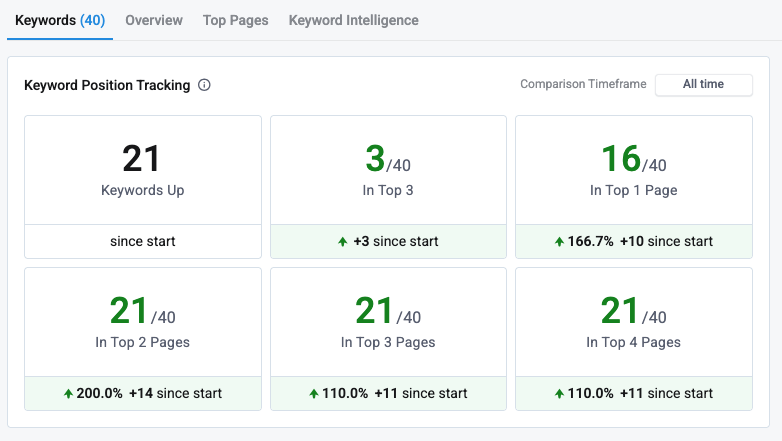
Keyword.com ranking tracking dashboard showing 16 page 1 rankings and 21 keywords improving for 3PL fulfilment SEO campaign managed by Kaan Turk

The Challenge

A third-party logistics (3PL) provider serving eCommerce businesses across Australia and New Zealand had a website that was actively working against its own SEO performance. The business offered a comprehensive suite of fulfilment services - pick and pack, warehousing, order management, inventory storage, and eCommerce fulfilment - with infrastructure to handle volumes ranging from startup brands to enterprise-scale operations. But despite having the service depth and geographic coverage to compete for high-value logistics keywords, the site was underperforming across the board.

When I analysed the site, I discovered a fundamental strategic error that was suppressing rankings for every keyword in the portfolio. The business's primary commercial keyword was "3PL" - the industry term that procurement managers, eCommerce founders, and operations directors use when searching for outsourced logistics partners. However, the homepage had been optimised around "fulfilment" instead, creating a misalignment between the site's most authoritative page and the keyword it should have been targeting.

This wasn't a minor optimisation oversight. It was a structural architecture problem that cascaded across the entire site:

The homepage was filtering for "fulfilment" keywords while the business's core identity and highest-value search queries centred on "3PL." This meant the site's strongest page - the homepage, which typically carries the most backlink equity and authority - was competing for a secondary keyword while leaving the primary keyword without a properly optimised landing page. Keyword cannibalisation had developed across multiple pages. Without clear keyword-to-page mapping, several pages were competing for overlapping terms, diluting the site's relevance signal for each individual keyword. Google couldn't determine which page should rank for which query, so none of them ranked well. The site hierarchy didn't reflect the logical service structure. Pages for related services - pick and pack, warehousing, order management - weren't connected in a parent-child architecture that would communicate topical relationships to Google. Each page existed in isolation rather than as part of a coherent service ecosystem. Content across existing service pages lacked the depth and specificity that B2B buyers and Google's algorithms expect for logistics and supply chain content.

For a 3PL business, the commercial stakes of organic search performance are substantial. A single enterprise fulfilment contract can be worth hundreds of thousands of dollars annually. Businesses searching for "3PL Australia" or "fulfilment services" are typically in active procurement mode - high-intent queries with significant commercial value behind every click.

The Strategy

The strategy was built around a complete site architecture restructure - not incremental optimisation of existing pages, but a fundamental rethinking of how the site's content was organised, how keywords mapped to pages, and how the internal hierarchy communicated the business's service structure to search engines.

I designed the new architecture around a clear principle: every page must have a single, distinct keyword target that aligns with its position in the site hierarchy. The homepage would own "3PL" as its primary keyword - the term that defines the business's core identity. Dedicated service pages would each target a specific service keyword - fulfilment, warehousing, pick and pack, order management - with no overlap between pages. Supporting content and tools would reinforce the topical authority of the commercial pages while providing standalone value that attracted links and traffic.

The 3PL and logistics market in Australia has a competitive characteristic that informed the approach. Unlike local service businesses where geographic proximity drives most queries, 3PL is a national and international market. Decision-makers search broadly - "3PL Australia," "fulfilment services," "eCommerce fulfilment" - and evaluate providers based on capability, pricing, and integration support rather than proximity. This means the SEO strategy needed to compete on topical authority and content depth rather than local signals.

The Implementation

Site Architecture Restructure

The architecture rebuild was the centrepiece of the campaign. I designed a new site hierarchy from scratch, built around the logical structure of the 3PL service model:

The homepage was repositioned as the primary "3PL" landing page - the definitive page on the site for the business's core keyword. All homepage content was rewritten to target 3PL-related queries while establishing the business's breadth of services, geographic coverage, and competitive positioning.

Beneath the homepage, dedicated service pages were created or restructured for each distinct service offering. Each page received its own primary keyword assignment with zero overlap:

A fulfilment services page targeting "fulfilment" and "fulfilment services" keywords. A warehousing page targeting "warehousing," "3PL warehousing," and warehouse-related queries. A pick and pack page targeting the operational keyword cluster. An order management page targeting eCommerce order processing queries. An eCommerce fulfilment page targeting the intersection of eCommerce and logistics queries.

The internal linking between these pages was engineered to reflect their semantic relationships. The homepage linked to all service pages, establishing them as child topics of the parent 3PL concept. Service pages cross-linked where services naturally connect - fulfilment linking to pick and pack, warehousing linking to inventory management. This created a topical cluster architecture that communicated to Google: this site comprehensively covers the 3PL domain from every angle.

Content Restructuring & Keyword Decannibalisation

With the new architecture defined, I rewrote the content across every key page to align with the revised keyword mapping. This wasn't cosmetic editing - it was a complete content restructure to ensure each page clearly targeted its assigned keyword while covering the entities and subtopics Google expects for that specific query.

The decannibalisation process required careful keyword analysis. Where multiple pages had previously competed for the same terms, I identified which page should own each keyword based on the new hierarchy, and rewrote the competing pages to focus on their designated targets. Internal linking was adjusted to reinforce these assignments - anchor text, contextual links, and navigation elements all pointed to the correct page for each keyword.

For the B2B logistics audience, the content needed to address specific decision-making criteria: integration capabilities with eCommerce platforms like Shopify, WooCommerce, and Amazon, scalability for growing brands, pricing transparency, and the operational specifics that differentiate one 3PL provider from another. Each page was written to address these buyer concerns while naturally incorporating the keyword targets.

Free Tool Development: Cost Calculator

One of the most effective elements of the campaign was the development of a fulfilment cost calculator - a free interactive tool that allowed potential clients to estimate their 3PL costs based on their order volumes, product dimensions, and service requirements.

The cost calculator served multiple strategic purposes. First, it addressed the most common question in the 3PL evaluation process: "how much will this cost?" By providing a free, no-commitment tool that generated approximate pricing, the site offered genuine value to visitors in the research and comparison phase of the buying journey - exactly the kind of utility that earns links, shares, and return visits.

Second, the calculator created a natural internal linking anchor. It could be referenced from blog content, linked from service pages, and promoted as a resource that reinforced the site's authority in the fulfilment pricing space. Pages and content that reference practical tools rank better because they demonstrate the kind of expert utility that Google's algorithms reward.

Third, the tool captured lead data. Users who completed the calculator were invited to receive a detailed quote based on their inputs, creating a warm lead pathway that converted anonymous visitors into identifiable prospects. Unlike a generic "contact us" form, the calculator pre-qualified leads with their volume requirements and service needs - information that made sales conversations significantly more productive.

Technical SEO & Schema Implementation

The technical layer ensured that the new architecture was properly communicated to search engines. XML sitemaps were regenerated to reflect the restructured hierarchy. Internal linking was audited to ensure no orphaned pages and no broken pathways. Page speed was optimised across the site, and Core Web Vitals were brought into compliance.

Schema markup was implemented with a focus on the B2B service model - Organisation schema, Service schema for each offering, and FAQ schema for the common logistics questions addressed on each page. The structured data gave Google clear, machine-readable information about the business's service categories, service areas (Australia and New Zealand), and the relationships between different service offerings.

The Results

Keyword.com ranking tracking showing 16 page 1 rankings and 21 keywords improving across 40 tracked terms for 3PL fulfilment SEO campaign
Keyword.com position tracking across 40 monitored keywords showing ranking improvements driven by the site architecture restructure.

The architecture restructure produced clear, measurable ranking improvements across the keyword portfolio.

Key Performance Metrics

Metric Before After Change
Keywords in Top 3 0 3 From zero
Keywords on Page 1 (Top 10) 6 16 +166.7%
Keywords in Top 20 7 21 +200.0%
Keywords in Top 30 10 21 +110.0%
Keywords in Top 40 10 21 +110.0%
Keywords Moving Up - 21/40 52.5% of tracked terms

Ranking Highlights

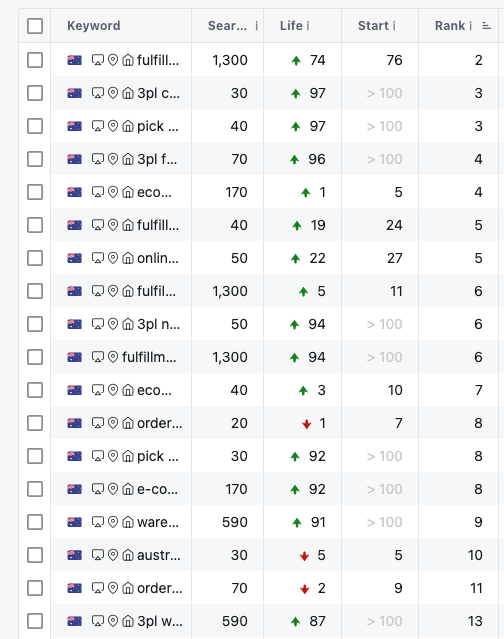
Keyword detail showing fulfilment, 3PL, warehousing, and eCommerce logistics keyword improvements
Keyword detail view showing ranking improvements across the full spectrum of 3PL service keywords.

The keyword detail demonstrates how the architecture fix resolved the cannibalisation issue:

"fulfilment" keywords (1,300 SV) - the highest-volume term moved from position 76 to position 2, a 74-position jump. A second fulfilment variant climbed from position 24 to 5, and a third moved from beyond 100 to position 6. The dedicated fulfilment page, freed from competing with the homepage, now has the clear authority to rank for its target keyword.

"3PL" keywords - 3PL-related terms moved from beyond position 100 into the top 10, reflecting the homepage's new optimisation focus. "3PL fulfilment" moved from beyond 100 to position 4. Other 3PL variants showed similar improvements as the homepage's authority was properly channelled.

"eCommerce" logistics keywords (170 SV) - improved from position 5 to 4, with related variants moving from position 10 to 7. The dedicated eCommerce fulfilment page captured these queries without competing with the broader fulfilment page.

"warehousing" keywords (590 SV) - moved from beyond position 100 to position 9, entering the first page for the first time. The new dedicated warehousing page, with its own targeted content and clear position in the site hierarchy, gave Google a specific page to rank for this query.

"pick and pack" keywords - moved from beyond position 100 into the top 10, another service vertical that gained a dedicated landing page through the restructure.

The Architecture Effect

The pattern across the results validates the core strategy. Before the restructure, the site's pages were competing with each other - cannibalising each other's ranking potential. After the restructure, each page had a clear keyword assignment, the internal linking reinforced those assignments, and Google responded by ranking the correct page for each query. The improvements weren't concentrated on one or two pages; they were distributed across the entire service portfolio, reflecting the systemic nature of the architecture fix.

Key Takeaways

1. Keyword cannibalisation is a silent ranking killer - and the fix can produce rapid results.
The site's homepage was optimised for "fulfilment" while the business's core identity was "3PL." This single misalignment suppressed rankings across the entire keyword portfolio. Restructuring the architecture to give each keyword a clear page assignment produced immediate, portfolio-wide improvements. If your site has multiple pages competing for the same keyword, this should be the first problem you solve.

2. Site architecture is an SEO strategy, not just a technical task.
The architecture restructure wasn't about fixing broken links or cleaning up URLs. It was a strategic decision about which pages should own which keywords and how the internal hierarchy should communicate topical relationships to Google. This strategic layer of architecture - keyword mapping, topical clustering, and cannibalisation resolution - is often the highest-leverage SEO work available.

3. Free tools earn authority and generate qualified leads simultaneously.
The fulfilment cost calculator attracted visitors who were actively evaluating 3PL options, provided genuine value through pricing transparency, and created a warm lead pathway that pre-qualified prospects with their specific requirements. For B2B businesses where the sales cycle is longer and lead quality matters more than volume, interactive tools can be more effective than traditional content marketing.

4. B2B SEO rewards specificity over volume.
In the 3PL market, a single contract can be worth more than thousands of consumer transactions. The SEO strategy didn't chase high-volume vanity keywords - it targeted the specific terms that procurement decision-makers use when evaluating fulfilment partners. Ranking on page 1 for "3PL fulfilment" or "eCommerce warehousing" puts the business in front of buyers with genuine purchase intent and significant budget authority.


About This SEO Campaign

Industry: 3PL / eCommerce Fulfilment & Logistics
Location: Australia and New Zealand (national)
Campaign Duration: Ongoing
Services Applied: Technical SEO, Content Strategy, eCommerce SEO, Schema Markup Implementation, Custom Tool Development
Primary Goal: Resolve keyword cannibalisation and establish page 1 rankings across core 3PL and fulfilment service keywords
SEO Consultant: Kaan Turk


Running a B2B service business where your pages seem to compete against each other in search results? Get in touch for a free SEO audit discussion - I'll map exactly where keyword cannibalisation is occurring and design an architecture that gives every page the best chance to rank.

On Page SeoTechnical SeoContent Strategy
Share:
KT
Kaan TURKAbout
Senior SEO Specialist

15 years of SEO expertise. Former SEO Lead for Louis Vuitton, LC Waikiki, Vakko, Enterprise Rent a Car, and Monster Notebook. Mathematics graduate bringing data-driven precision to search engine optimisation.

Want Similar Results for Your Business?

Every project starts with understanding your unique challenges. Let's discuss how we can transform your organic presence.