Case StudyIndustrial Shelters & Dome Structures
10 min read

Dome Shelter SEO Case Study: From Deindexed to 73 Page 1 Rankings After a Failed Migration

How a Perth-based dome shelter company recovered from a failed website migration - deindexed, full of 404 errors, and stripped of content - to secure 73 page 1 keyword rankings in just 9 months.

73 keywords on page 1 (+356.3%)
Primary Result
433.3% increase in top 3 keyword rankings
Secondary Result
9 months
Timeframe
Technical SeoEcommerce SeoOn Page SeoContent Strategy
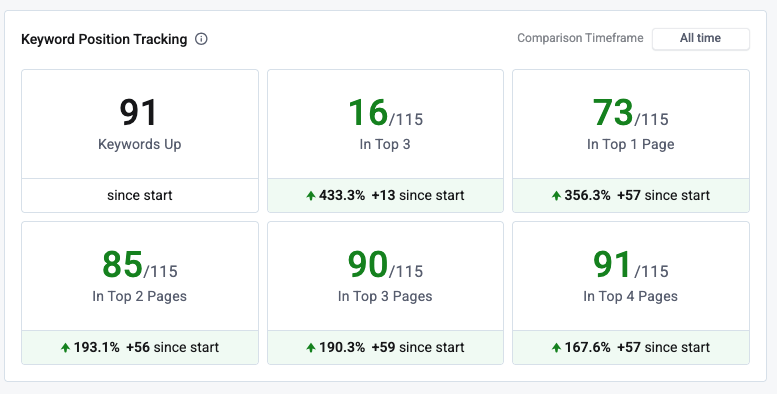
Keyword.com ranking tracking dashboard showing 356% page 1 growth and 91 keywords improving for dome shelter SEO migration recovery campaign managed by Kaan Turk

The Challenge

A Perth-based dome shelter manufacturer came to me in a state of emergency. The business - a supplier of industrial dome shelters, storage covers, and container shelters serving customers across Australia - had just gone through a website migration that had gone catastrophically wrong. The consequences were immediate and severe: the entire site had been marked as noindex, effectively removing every single page from Google's search results overnight.

For a business that relied on organic search to generate enquiries for high-value industrial products, disappearing from Google wasn't a minor setback - it was an existential threat. Every day the site remained deindexed was a day of lost leads, lost revenue, and competitors filling the gap.

When I ran the initial SEO audit, the migration damage extended far beyond the noindex issue. The full picture revealed a site in critical condition:

The noindex directive had been applied site-wide during the migration process and never removed, telling Google to exclude every page from its index. Dozens of previously indexed URLs were now returning 404 errors - pages that had accumulated backlinks and authority over years were simply gone, with no redirects in place. The backlinks pointing to these dead URLs were effectively wasted, providing zero SEO value to the new site. Across the entire website, including the homepage, the content was extremely thin. The site was heavily image-dependent - product photos of dome shelters and installations - with minimal supporting text content. This meant Google had almost nothing to crawl, understand, or rank. Meta titles and descriptions were missing or duplicated across multiple pages. Image alt text was absent throughout the site, meaning the extensive product photography contributed nothing to the site's search relevance.

This wasn't a typical optimisation engagement. It was a rescue mission. The site needed emergency triage followed by systematic reconstruction of every SEO signal that the failed migration had destroyed.

The Strategy

The strategy was divided into two clear phases: emergency recovery and systematic rebuilding. The first priority was stopping the bleeding - getting the site back into Google's index as fast as possible. The second was rebuilding the technical, content, and authority foundations properly so the site wouldn't just recover to its pre-migration state but surpass it.

For a niche industrial product like dome shelters, the SEO landscape has a specific characteristic that worked in the client's favour: the competition is relatively shallow compared to consumer markets. Most competitors in this space have basic websites with limited SEO investment. This meant that once the recovery work was complete, a properly optimised site could dominate the category relatively quickly - provided the foundational work was done thoroughly.

I structured a 9-month engagement that would progress from emergency fixes through technical rebuilding, content creation, and finally eCommerce optimisation for the product pages that drove purchase enquiries.

The Implementation

Emergency Deindexing Recovery

The first action was immediate. I identified and removed the noindex directives that were blocking the entire site from Google's index. A manual indexing request was submitted through Google Search Console for all priority pages to accelerate the re-crawling process. Within the first week, key pages began reappearing in search results - but reappearing with all the pre-existing problems still intact.

Technical SEO Audit & 301 Redirect Mapping

With the site back in Google's index, I conducted a comprehensive technical audit to map the full extent of the migration damage. This revealed the scale of the 404 problem: dozens of previously indexed URLs that had been restructured or removed during the migration were returning errors, and every one of those dead URLs represented lost link equity.

I built a complete 301 redirect map, matching every old URL to its correct new destination. This wasn't a bulk redirect-everything-to-homepage approach - each redirect was mapped individually to the most relevant corresponding page on the new site. The goal was to recover as much of the accumulated backlink authority as possible by ensuring link equity flowed to the right pages rather than being diluted or lost entirely. For URLs where no equivalent page existed on the new site, I identified the closest topically relevant page and redirected accordingly.

This redirect mapping also cleaned up the user experience. Any external links, bookmarks, or cached search results pointing to old URLs now landed visitors on the correct page rather than a dead end.

Content Creation From Scratch

The thin content problem was arguably the biggest long-term obstacle. A website selling industrial dome shelters should be rich with information - product specifications, use cases, installation details, comparison guides, compliance information, and industry-specific content. Instead, nearly every page consisted of product images with little to no supporting text.

I wrote SEO-optimised content from scratch for every target page on the site. For the homepage, this meant a complete rewrite that established the business as a dome shelter authority - covering the product range, the Australian applications, the target industries, and the key differentiators. For product and category pages, I created content that balanced search optimisation with genuine commercial utility: detailed descriptions, specification highlights, use case scenarios, and the kind of technical depth that both Google and prospective buyers expect from a specialist manufacturer.

Every piece of content was built around targeted keyword research, with primary and secondary keywords mapped to specific pages to prevent cannibalisation. The content also incorporated the semantic entities that Google associates with the dome shelter and industrial storage category - materials, dimensions, compliance standards, installation methods, and application contexts.

On-Page SEO & Image Optimisation

With content in place, I worked through the full on-page SEO checklist across every page on the site. Unique, keyword-targeted meta titles were written for each page. Meta descriptions were crafted to maximise click-through rate from search results. The heading hierarchy was structured to reflect the content architecture and keyword targeting.

The image optimisation work was particularly important for this site given its heavy reliance on product photography. Every image received descriptive, keyword-relevant alt text - transforming what had been a bank of invisible images into an active SEO asset. Image file names were updated to follow SEO naming conventions, and compression was applied to improve page load times without sacrificing visual quality.

eCommerce Schema Implementation

As a site that sells products online, structured data was essential for both visibility and rich result eligibility. I implemented comprehensive eCommerce schema across the product pages, including product schema with offer, price, and availability markup. This gave Google explicit, structured information about every product the business sells - information that can surface as rich results in search and improve click-through rates from product-related queries.

Additional schema types were implemented site-wide, including organisation schema, breadcrumb schema for navigation, and FAQ schema where appropriate. Together, these structured data enhancements provided Google with a clear, machine-readable understanding of what the site is, what it sells, and how it's structured.

The Results

Keyword ranking tracking dashboard
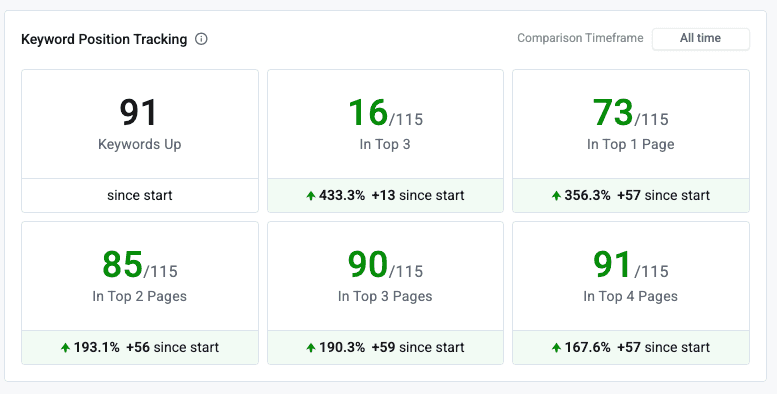
Keyword.com position tracking across 115 monitored keywords showing comprehensive ranking recovery and growth over 9 months.

The recovery was comprehensive. Within 9 months, the site didn't just return to its pre-migration performance - it dramatically exceeded it.

Key Performance Metrics

Metric Before After Change
Keywords in Top 3 3 16 +433.3%
Keywords on Page 1 (Top 10) 16 73 +356.3%
Keywords in Top 20 29 85 +193.1%
Keywords in Top 30 31 90 +190.3%
Keywords in Top 40 34 91 +167.6%
Keywords Moving Up - 91/115 79.1% of tracked terms

Recovery Trajectory

The results tell a story of systematic, compounding recovery. Out of 115 tracked keywords, 91 moved up in rankings - that's 79% of the entire monitored portfolio improving. The site went from having just 16 keywords on page one to 73, placing the business in a dominant position across the dome shelter category in Australia.

The top 3 growth is particularly significant. Moving from 3 to 16 keywords in the most competitive positions means the site isn't just visible - it's commanding the search results for the highest-value queries in this niche. For an industrial product category where a single enquiry can be worth thousands of dollars, owning those top positions translates directly to revenue.

What makes this recovery remarkable is the starting point. This wasn't a site that needed incremental optimisation - it was a site that had been effectively erased from Google. Rebuilding from deindexed to category dominance in 9 months required every layer of SEO to work together: the technical recovery restored access, the redirect mapping recovered authority, the content creation established relevance, and the on-page optimisation and schema markup refined the signals. None of these layers alone would have been sufficient.

Key Takeaways

1. A failed website migration can be recovered - but speed matters.
The longer a site remains deindexed or broken after a migration, the harder the recovery becomes. Competitors fill the gap, backlink equity degrades, and Google's understanding of the site deteriorates. The first 48 hours after identifying a migration failure are critical. In this case, getting the noindex directives removed and indexing requests submitted immediately prevented what could have been months of additional damage.

2. 301 redirect mapping is not optional in any site migration.
Every migration should include a complete URL-to-URL redirect map before the switch happens. When it doesn't - as in this case - the cleanup work is significantly more complex and some link equity will inevitably be lost. The redirect mapping I built recovered a substantial portion of the site's accumulated authority, but a properly planned migration would have preserved it entirely.

3. Image-heavy sites need text content to rank.
Google cannot rank what it cannot read. A site full of beautiful product photos but minimal text content is effectively invisible to search engines. For industrial and product-focused businesses, the content doesn't need to be lengthy - but it needs to exist, it needs to target specific keywords, and it needs to cover the entities Google expects in that product category.

4. Niche industrial markets reward thorough SEO disproportionately.
In a category like dome shelters, most competitors invest minimally in SEO. This means that a properly optimised site can achieve dominant rankings faster than in more competitive consumer markets. The investment-to-return ratio for SEO in niche industrial categories is often among the highest of any digital marketing channel.


About This SEO Campaign

Industry: Industrial Shelters & Dome Structures
Location: Perth, Western Australia
Campaign Duration: 9 months
Services Applied: Technical SEO, eCommerce SEO, Content Strategy, Link Building (redirect recovery), Schema Markup Implementation
Primary Goal: Recover from failed website migration and establish page 1 rankings across dome shelter product keywords
SEO Consultant: Kaan Turk


Dealing with the aftermath of a website migration gone wrong? Get in touch for a free SEO audit discussion - I'll assess the damage, identify what's recoverable, and give you an honest timeline for getting your rankings back.

Technical SeoEcommerce SeoOn Page SeoContent Strategy
Share:
KT
Kaan TURKAbout
Senior SEO Specialist

15 years of SEO expertise. Former SEO Lead for Louis Vuitton, LC Waikiki, Vakko, Enterprise Rent a Car, and Monster Notebook. Mathematics graduate bringing data-driven precision to search engine optimisation.

Want Similar Results for Your Business?

Every project starts with understanding your unique challenges. Let's discuss how we can transform your organic presence.